Most visitors to Egypt follow the same arc: Cairo, the Pyramids, the Nile cruise, Luxor, Aswan. It is a magnificent arc — the greatest concentration of ancient monuments anywhere on Earth, strung along 900 kilometres of river. But Egypt is also a country that extends far beyond the Nile Valley, into deserts that cover 96% of its land area, and within those deserts are landscapes and communities that have nothing in common with pharaonic Egypt and everything to offer a curious traveller. The most remarkable of these is Siwa Oasis.
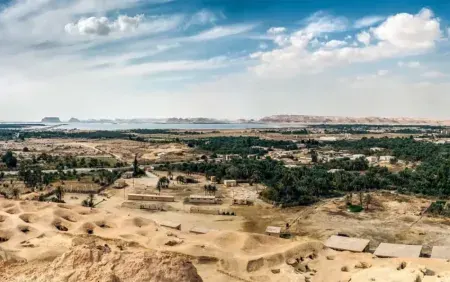
Siwa sits in a natural depression in the Eastern Sahara — part of the Libyan Desert — at approximately 60 metres below sea level, its floor covered by freshwater springs, salt lakes, date palm groves, and olive orchards. It is 560 kilometres west of Cairo by road, 300 kilometres from the Libyan border, and far enough from the Nile Valley that it developed an entirely independent culture, language, and architectural tradition over thousands of years. The people of Siwa are not Arabs and not Egyptians in the cultural sense — they are Berber (Amazigh), part of the indigenous North African population that predates the Arab expansion, and they speak Siwi, a Berber language with no relationship to Arabic, though most also speak Arabic today. Their pottery, their basket-weaving, their jewellery, their dress, and their food are all distinctly Siwan — a culture that has maintained itself in relative isolation for millennia and that is unlike anything else in Egypt.
Quick Facts: Siwa Oasis
| Location | Libyan Desert, north-western Egypt — 560 km west of Cairo, 300 km from Libya |
| Elevation | ~60 metres below sea level — a natural desert depression |
| Population | ~35,000 — predominantly Berber (Amazigh), speaking Siwi language |
| Springs | Over 200 freshwater springs — including the famous Cleopatra's Spring (Ain Guba) |
| Date palms | ~300,000 date palms — Siwa dates are among the finest in Egypt |
| Salt lakes | Several — including Birket Siwa and Birket Zeitoun; flamingos and migratory birds present |
| Key ancient sites | Oracle Temple of Amun (Aghurmi) · Temple of Umm Ubayd · Mountain of the Dead (Gebel el-Mawta) |
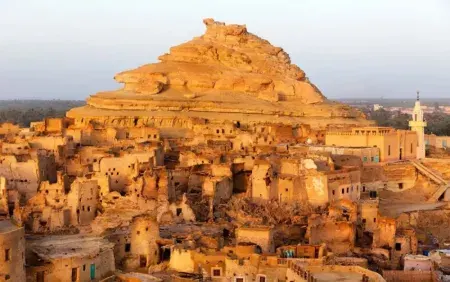
| The Shali fortress | Medieval salt-brick citadel at Siwa's centre — largely dissolved by 3 days of rain in 1926 |
| How to get there | By road from Cairo (~8 hours) or from Alexandria (~5 hours) — no airport; no rail connection |
| Best time to visit | October–April (cool days, cold nights) — summer is extremely hot (45°C+) |
| Recommended stay | Minimum 3 nights — ideally 4–5 to cover all sites and a Great Sand Sea safari |
| Transport in Siwa | Donkey cart (the traditional Siwan vehicle), bicycle hire, or 4WD for desert excursions |
The Oracle Temple of Amun: Where Alexander the Great Came for Answers
The site that made Siwa famous in the ancient world is the Oracle Temple of Amun, perched on the rocky Aghurmi outcrop at the edge of the modern town. The oracle at Siwa was one of the three most important oracles in the ancient Mediterranean world — alongside Delphi in Greece and Dodona in Epirus — and was consulted by rulers and pilgrims from across Egypt, Greece, Libya, and the Levant for over a thousand years, from at least the 6th century BC through the Roman period.
The oracle's greatest and most historically resonant consultation took place in 331 BC, when Alexander the Great made the extraordinary decision to cross the Libyan Desert from the Egyptian coast — a journey of several days through waterless terrain — to consult the oracle of Amun at Siwa. The journey itself was near-suicidal: ancient sources describe the expedition becoming lost in a sandstorm before being guided to Siwa by birds (or by snakes, in some versions). What Alexander asked the oracle and what he was told is one of history's great mysteries — he reportedly kept the oracle's answer private for the rest of his life. What is known is that the priests of Amun greeted him as the "son of Amun" — identifying him as a god-king in the Egyptian tradition — and that Alexander left Siwa convinced of his divine mission to conquer the world. The oracle's endorsement transformed his self-understanding and his military strategy.
What no other guide tells you: Alexander the Great reportedly asked to be buried at Siwa. His body was in fact initially taken toward Siwa after his death in Babylon in 323 BC, but was intercepted in Egypt and eventually interred in Alexandria. The location of Alexander's tomb — one of the great unsolved mysteries of archaeology — has never been confirmed, but Siwa has periodically been proposed as a possibility. Greek archaeologist Liana Souvaltzi claimed to have found it at Siwa in the 1990s; the claim was not accepted by the Egyptian authorities, but the mystery remains open.
What to See and Do in Siwa
The Oracle Temple (Temple of Amun) — Aghurmi
The 26th Dynasty temple (c. 664–525 BC) on the Aghurmi rock is modest in its current state — much of the stonework has been robbed or eroded — but the setting is extraordinary: a natural rock outcrop rising above the palm groves with panoramic views across the oasis floor to the salt lakes. The inner sanctuary where Alexander consulted the oracle is still standing, its inscribed walls still partially legible. A short walk connects Aghurmi to the nearby Temple of Umm Ubayd (also dedicated to Amun, built under Nectanebo II, c. 360 BC) — now reduced to a single standing wall but with fine carved reliefs.
Cleopatra's Spring (Ain Guba)
Cleopatra's Spring is a large circular natural pool of fresh spring water — crystal clear, slightly cool, and connected to the ancient aquifer that sustains the entire oasis. The name is modern and romanticised (there is no evidence Cleopatra visited Siwa) but the spring is ancient — it appears in classical texts as one of the landmark features of the oasis. Locals and visitors swim in it. The water temperature is constant year-round at approximately 28°C regardless of air temperature. It is one of the most pleasant swimming spots in Egypt and one of the few places in the country where you can swim in naturally occurring fresh spring water.
The Shali Fortress
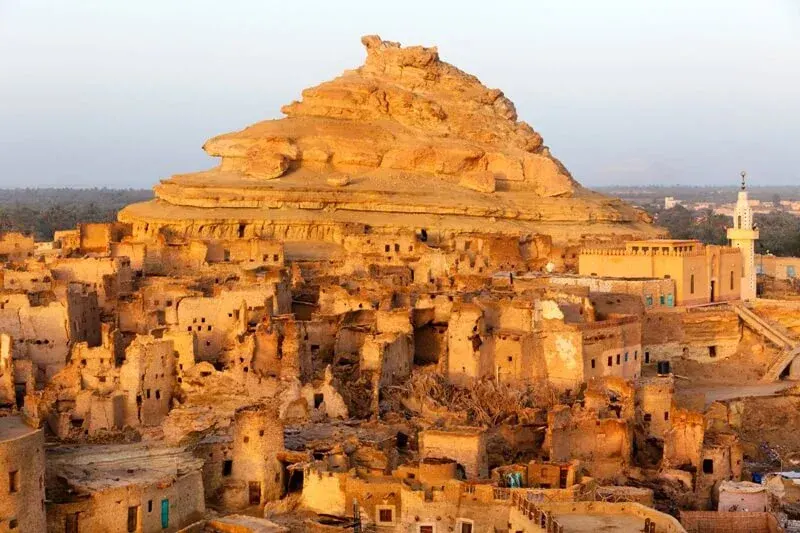
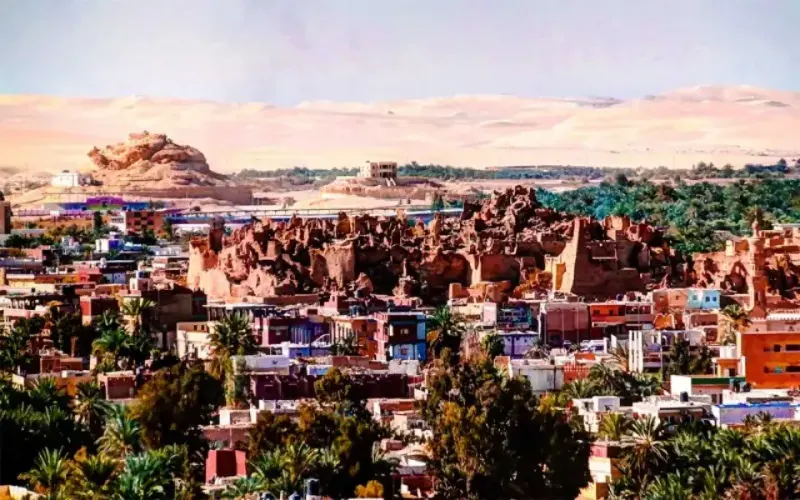
At the centre of Siwa town, the ruins of the Shali fortress occupy a natural rock promontory. Shali was built in the 13th century AD from kershef — a mixture of salt, mud, and sand used as the traditional Siwan building material — and housed the entire population of the oasis within its walls for protection against Bedouin raids. In 1926, three consecutive days of unusually heavy rain dissolved much of the salt-brick structure, reducing it to the organic-looking eroded forms visible today. The ruins are lit at night and can be climbed (carefully) for the best views over the oasis. Siwan craftsmen still use kershef for traditional construction — the material gives Siwa's older buildings their distinctive warm brown, almost geological appearance.
Mountain of the Dead (Gebel el-Mawta)
A rocky hill on the northern edge of the oasis, Gebel el-Mawta is honeycombed with ancient tombs dating primarily to the 26th Dynasty and the Ptolemaic period. The painted tomb of Si-Amun is the finest — its walls decorated with vivid scenes including a rare image of the tomb owner with distinctly non-Egyptian features (curly hair, lighter skin) suggesting a Greek or Libyan identity. During World War II, the local population sheltered in the Gebel el-Mawta tombs during Allied and Axis overflights — protecting themselves in spaces that had been built for exactly this purpose 2,500 years earlier.
The Great Sand Sea Safari
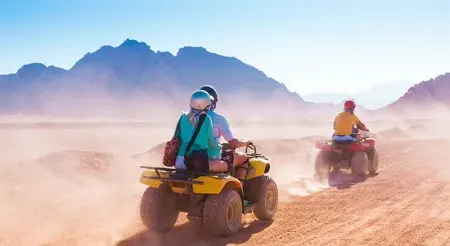
West and south of Siwa, the Great Sand Sea begins — one of the largest continuous sand seas on Earth, extending over 72,000 square kilometres across the Egyptian-Libyan border. 4WD safaris into the Great Sand Sea are the most popular activity in Siwa, combining dune driving, sandboarding, and camping under some of the darkest skies in Africa (Siwa has no meaningful light pollution). The standard full-day safari includes a visit to a desert spring for swimming, a picnic lunch among the dunes, and a sunset from the highest accessible dune with views across the sand sea to the horizon. Egypt For Travel's Siwa Oasis Tour from Cairo includes the full Great Sand Sea safari as standard.

Siwan Culture: The Berber World at Egypt's Western Edge
Siwa's cultural distinctiveness is immediately apparent to any visitor. The language spoken in the market, the architecture of the older houses, the patterns on the pottery and baskets, the style of the silver jewellery, the preparation of the food — all differ fundamentally from the Arab-Egyptian culture of the Nile Valley. The Siwans are Berber (Amazigh) — part of the indigenous North African population whose ancestors inhabited the Sahara and the coastal Maghreb long before the Arab expansion of the 7th century AD. Siwi, their language, belongs to the Berber language family and is closely related to the dialects of Libya and Tunisia, not to Arabic.
Traditional Siwan silver jewellery — elaborate necklaces, headdresses, and bracelets — is among the finest Berber metalwork in North Africa and is sold in the Siwa market alongside hand-woven baskets, embroidered textiles, and locally produced olive oil and dates. The Siwa olive grove — over 70,000 trees — produces oil of exceptional quality that is bottled and sold under local brands. Siwa dates, harvested in autumn, are sold fresh, dried, and pressed into date syrup throughout Egypt.
| Siwa Experience | What It Is | Best For |
|---|---|---|
| Oracle Temple visit | Ancient 26th Dynasty temple on Aghurmi rock — where Alexander consulted the oracle in 331 BC | History enthusiasts; Alexander the Great connection |
| Cleopatra's Spring swim | Natural freshwater pool — 28°C year-round, crystal clear | Everyone — one of Egypt's most refreshing experiences |
| Great Sand Sea safari | Full-day 4WD into the largest sand sea in Africa — dunes, desert springs, sunset, stargazing | Adventure travellers; photographers; families |
| Shali sunset | Climbing the medieval kershef fortress ruins at golden hour for panoramic oasis views | Photographers; romantic travellers |
| Gebel el-Mawta tombs | Painted 26th Dynasty tombs — the Si-Amun tomb has unique non-Egyptian iconography | History and archaeology enthusiasts |
| Siwa market & crafts | Silver Berber jewellery, hand-woven baskets, olive oil, dates — all locally produced | Shoppers; culture travellers; foodies |
| Salt lake kayak / swim | Birket Siwa and surrounding lakes — high salinity means effortless floating; flamingos present seasonally | Nature lovers; relaxation seekers |
Where to Stay in Siwa: Ecolodges and Traditional Accommodation
Siwa has developed a distinctive accommodation style that suits the oasis perfectly: ecolodges built from kershef (traditional salt-brick), with palm-wood ceilings, hand-woven furnishings, and gardens of date palms and olive trees. These are not luxury hotels in any conventional sense — they are beautiful, quiet, and deeply connected to the landscape. Egypt For Travel's Siwa package uses the Ghaliet Ecolodge, the Kenoz Shali Lodge, or the Albabenshal Lodge (or similar) depending on availability.
A special experience on Egypt For Travel's Siwa tour is a dinner at Taziry Eco-Village — a luxury ecolodge and sustainable development project on the edge of the Great Sand Sea, serving traditional Siwan cuisine under the open desert sky. Dishes include slow-roasted lamb, date and olive salads, Siwan bread, and local olive oil — ingredients grown or raised within the oasis itself.

Practical Visitor Guide — Siwa Oasis
| Detail | Information |
|---|---|
| Getting there | By road from Cairo (~8 hours, 560 km) or Alexandria (~5 hours, 300 km) — Egypt For Travel provides private transfer |
| Best time | October–April — days 20–28°C, nights cool; October is date harvest season (beautiful and festive) |
| Avoid | June–August — extreme heat (45°C+); the Great Sand Sea is genuinely dangerous in summer |
| Dress code | Conservative — Siwa is a traditional Berber community; modest dress required especially for women in the town |
| Currency | Cash (Egyptian pounds) essential — no ATMs reliably function; bring sufficient cash from Cairo |
| Photography | Always ask before photographing local people — particularly women; the oasis and landscapes are freely photographed |
| Recommended stay | 3 nights minimum; 4–5 nights ideal to include Great Sand Sea overnight camping |
| Connectivity | Mobile data limited; WiFi at most ecolodges; treat it as a digital detox destination |
Frequently Asked Questions — Siwa Oasis
How far is Siwa from Cairo?
Siwa is approximately 560 kilometres west of Cairo — about 8 hours by road. Egypt For Travel provides private air-conditioned vehicle transfers from Cairo as part of the Siwa Oasis Tour package. There is no airport at Siwa and no railway connection.
What is the Oracle Temple of Siwa?
The Oracle Temple of Amun at Siwa (on the Aghurmi rock) was one of the three most important oracles of the ancient Mediterranean world. Built during the 26th Dynasty (664–525 BC), it was consulted by rulers and pilgrims from Egypt, Greece, and the broader Mediterranean for over a thousand years. Its most famous visitor was Alexander the Great, who made the desert crossing in 331 BC to consult the oracle — and was reportedly greeted as the son of Amun.
Is Siwa safe to visit?
Yes — Siwa is safe and welcoming for international visitors. It is a conservative Berber community and visitors should dress modestly and be respectful of local customs, particularly around women. Egypt For Travel's guided tours ensure visitors are accompanied by knowledgeable local guides throughout.
What language do people speak in Siwa?
The native language of Siwa is Siwi — a Berber (Amazigh) language unrelated to Arabic. Most Siwans also speak Arabic, and English is spoken at ecolodges, tourist sites, and restaurants. The survival of Siwi as a living language is a remarkable cultural achievement in a country that speaks almost exclusively Arabic.
What is the Great Sand Sea?
The Great Sand Sea is one of the largest continuous sand seas on Earth — covering approximately 72,000 square kilometres across north-western Egypt and north-eastern Libya. It consists of enormous parallel sand dunes (some over 100 metres high) formed by persistent north-west winds over millions of years. Egypt For Travel's Siwa Oasis Tour includes a full-day 4WD safari into the Great Sand Sea.
Can I swim at Siwa?
Yes — Siwa has two main swimming options. Cleopatra's Spring (Ain Guba) is a natural freshwater pool at a constant 28°C, crystal clear and very pleasant. The salt lakes (Birket Siwa and others) offer a Dead Sea-style floating experience due to their high salinity. There are also freshwater desert pools within the Great Sand Sea that are included in Egypt For Travel's safari itinerary.
Visit Siwa Oasis with Egypt For Travel on our 3-day Siwa Oasis Tour from Cairo — explore Siwa tours and prices. Round-trip private transfer from Cairo · 2 nights ecolodge accommodation · Full-board meals · Great Sand Sea safari · All site visits included. WhatsApp: +20 155 555 2466. ETA Licence No. 1947.