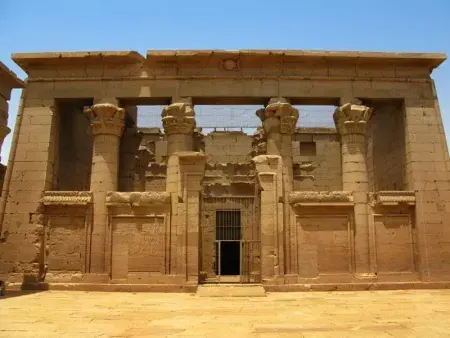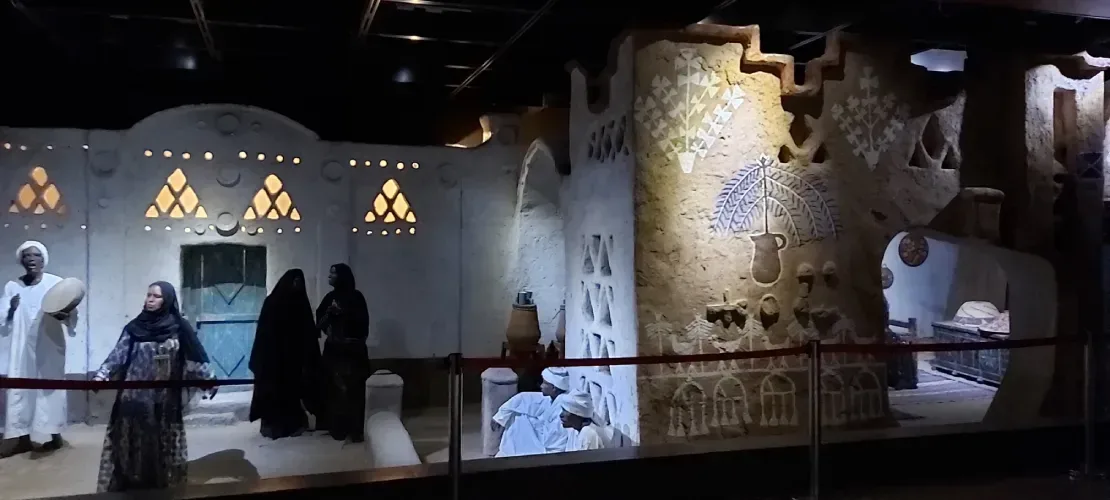
When Egypt asked UNESCO for help saving the monuments of Nubia from the rising waters of Lake Nasser in the 1960s, the international response was unprecedented — but the rescue operation saved only the largest and most visible structures. The villages, cemeteries, vernacular architecture, household objects, rock art, and smaller archaeological sites of ancient Nubia — the lived texture of a civilisation that had existed for more than 10,000 years — largely disappeared beneath 180 billion cubic metres of water. What survived was collected, catalogued, and eventually given a home in one of the finest purpose-built museum buildings in Africa: the Nubian Museum in Aswan, opened in 1997 after more than a decade of planning and construction.
The Nubian Museum is not a consolation prize for a lost civilisation. It is a genuine act of cultural restoration — a building designed to honour and explain a people and a history that Egyptian and international tourism had largely overlooked. For visitors to Aswan, it provides the essential context that transforms a sequence of impressive monuments into a coherent story. After the Nubian Museum, the temples of Lake Nasser make sense. After the Nubian Museum, the Aswan High Dam becomes a moral as well as an engineering achievement. After the Nubian Museum, Nubia becomes a place, not just a word.
Quick Facts: The Nubian Museum
| Opened | 1997 — inaugurated by President Hosni Mubarak; result of UNESCO–Egypt collaboration |
| Architect | Mahmoud El-Hakim (Egyptian) — designed to integrate with the Aswan hillside and Nile landscape |
| Location | Abtal el-Tahrir Street, Aswan — near the Old Cataract Hotel, on the hillside above the Nile |
| Collection size | Over 3,000 artefacts on display; tens of thousands in storage |
| Time span covered | Prehistoric Nubia (50,000 BC) through pharaonic, Napatan, Meroitic, Christian, and Islamic periods |
| Award | Aga Khan Award for Architecture (2001) — one of the most prestigious architectural prizes in the world |
| Entrance fee (2026) | ~400 EGP (~$8 USD) |
| Opening hours | Daily 09:00–13:00 and 17:00–21:00 (two sessions — confirm locally as hours may vary seasonally) |
| Time needed | 2–3 hours for a thorough visit |
| Garden | Landscaped garden with outdoor exhibits including rock art panels, a reconstructed Nubian house, and pharaonic-era statuary |
| Best combined with | Philae Temple · Aswan High Dam · Unfinished Obelisk |
The Building: Architecture as a Cultural Statement
The Nubian Museum building is itself a significant work of architecture. Designed by Egyptian architect Mahmoud El-Hakim and completed after more than a decade of planning, the building is built into the Aswan hillside above the Nile in a way that references Nubian architectural traditions — stepped facades, thick stone walls, natural ventilation — while providing modern museum-standard climate control and display conditions. The building won the Aga Khan Award for Architecture in 2001, the most prestigious prize in Islamic and regional architecture, specifically for its success in creating a contemporary building that honours its cultural and geographical context without resorting to pastiche.
The approach to the building through a landscaped garden — which contains outdoor exhibits including pharaonic-era statuary, relocated rock art panels (petroglyphs transferred from Nubian sites before they were flooded), and a reconstructed Nubian village dwelling — prepares visitors for the collection inside by establishing the breadth of what Nubian culture encompassed: from prehistoric hunters who carved images of animals on desert rock faces, to farmers who built mud-brick villages on the Nile bank, to kings who ruled an empire stretching from Khartoum to the Mediterranean.
What no other guide tells you: The Nubian Museum was specifically built in Aswan — rather than in Cairo — as a deliberate political and cultural statement. The Nubian people, who were displaced from their homeland by the rising waters of Lake Nasser in the 1960s, were resettled in villages north of Aswan. Building the museum in their city of resettlement, rather than in the national capital, acknowledged the local community as the primary custodians of the heritage it houses — a recognition that was meaningful to a community that had lost everything else.

What to See: The Collection Room by Room
Prehistory and Early Nubian Cultures (50,000–3100 BC)
The museum's journey begins in deep prehistory — with stone tools from Palaeolithic Nubian settlements dating back 50,000 years, followed by extraordinary Neolithic pottery from the A-Group culture (c. 3800–3100 BC), which traded with predynastic Egypt and produced some of the finest hand-made ceramics of the ancient world. The contrast between Egyptian and Nubian ceramic traditions at this early period is already visible: where Egyptian pottery emphasises geometric decoration, the Nubian A-Group ware uses a distinctive black-topped red ware that has no Egyptian parallel and represents an independent aesthetic tradition.
The Kerma Kingdom (2500–1500 BC)
The Kingdom of Kerma — centred at the Third Cataract in modern Sudan — was Egypt's great Nubian rival during the Middle Kingdom period, powerful enough to ally with the Hyksos invaders of Egypt and threaten the very existence of the Egyptian state. Kerma produced extraordinary burial goods: enormous circular burial tumuli containing the ruler surrounded by hundreds of sacrificed retainers, and faience inlay work of astonishing delicacy. The Nubian Museum's Kerma collection is one of the finest outside Khartoum.
The New Kingdom and Egyptian Rule (1550–1069 BC)
During the New Kingdom, Egypt conquered and administered Nubia as far south as the Fourth Cataract — a colonial system managed through Egyptian viceroys (the "Viceroy of Kush") and sustained by the temples and garrisons whose remains line the Lake Nasser shores. The museum's New Kingdom galleries display the artefacts of this colonial period: Egyptian-style statuary produced by Nubian craftsmen, administrative objects in both hieroglyphic and Meroitic script, and the burial goods of Nubian officials who served the Egyptian administration and adopted Egyptian customs while maintaining distinctly Nubian identities.
The Napatan and Meroitic Kingdoms (750 BC–350 AD)
In one of history's great reversals, the Nubian kingdom centred at Napata (near the Fourth Cataract) conquered Egypt in 747 BC and ruled it for approximately 70 years as the 25th Dynasty — the so-called "Kushite" or "Black Pharaohs." The Nubian Museum's 25th Dynasty galleries display the extraordinary art produced during this period: royal statuary combining Egyptian pharaonic conventions with distinctly Nubian facial features and dress, double-cobra uraeus crowns unique to Nubian kingship, and the monumental architecture of rulers who simultaneously maintained Egypt's traditions and expressed their own cultural identity. The subsequent Meroitic Kingdom (270 BC–350 AD) developed its own script — still only partially deciphered — and produced a distinctive artistic tradition visible in the museum's later galleries.
Christian and Islamic Nubia (350–1500 AD)
The museum's final galleries cover the Christian period in Nubia — when Nubian kingdoms converted to Christianity in the 6th century AD and maintained Christian cultures for nearly a millennium, producing extraordinary wall paintings from cathedral sites that rival Byzantine art in sophistication — and the gradual Islamisation of Nubia from the 14th century onward. The continuity of Nubian cultural identity across these shifts — pharaonic, Egyptian colonial, Napatan, Meroitic, Christian, Islamic — is one of the museum's most powerful arguments.
The Nubian People Today: Displacement and Identity
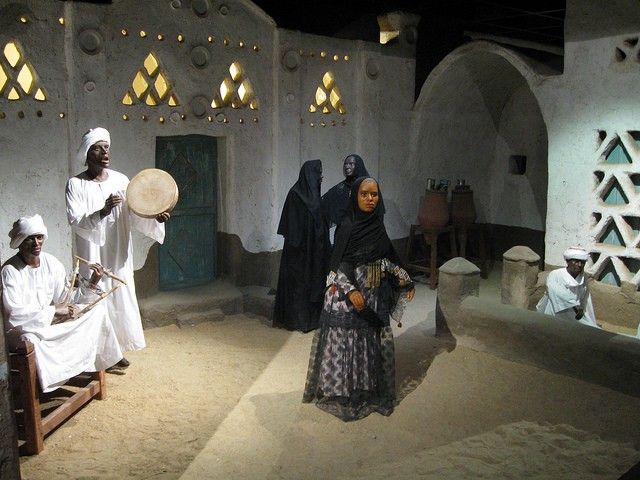
The Nubian Museum exists because of one of the 20th century's most dramatic acts of cultural displacement. When the Aswan High Dam was completed in 1970, approximately 100,000 Nubian people were forcibly relocated from their ancestral homeland — the villages, farms, cemeteries, and sacred sites that lined the Nile valley between the First and Second Cataracts — to resettlement villages north of Aswan in Egypt and in Khashm el-Girba in Sudan. They left behind not just buildings and belongings but an entire geography of meaning: the places where their families had lived, worshipped, and been buried for generations.
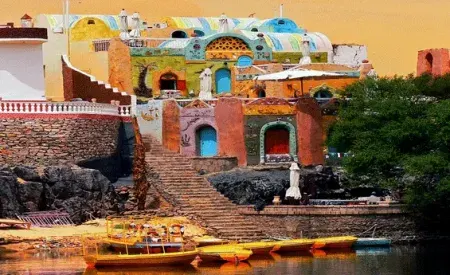
The Nubian community in Egypt today numbers approximately three million people, living primarily in and around Aswan and in diaspora communities in Cairo and abroad. They maintain a distinct language (two main dialects: Nobiin and Kenuzi-Dongola), a distinct music tradition, a distinct architectural aesthetic (the brightly painted facades of Nubian houses are immediately recognisable), and a profound attachment to a homeland that no longer exists above water. A visit to a Nubian village near Aswan — typically by felucca to Elephantine Island or by boat to the west bank villages — is the recommended complement to the Nubian Museum, bringing the living culture into contact with its historical depth.
Practical Visitor Guide — Nubian Museum
| Detail | Information |
|---|---|
| Location | Abtal el-Tahrir Street, Aswan — 10 min walk from the Corniche; near the Old Cataract Hotel |
| Entrance fee (2026) | ~400 EGP (~$8 USD) |
| Opening hours | Daily 09:00–13:00 and 17:00–21:00 — confirm locally as hours vary seasonally |
| Time needed | 2–3 hours for a thorough visit including the garden |
| Best time to visit | Morning session (09:00–12:00) — cooler, fewer visitors; or evening session (17:00–21:00) for cool air and atmospheric lighting |
| Photography | Permitted throughout — garden especially photogenic; indoor displays well lit |
| Accessibility | Ramp access throughout main galleries; garden paths are flat; some exterior steps |
| Café / facilities | Small café on site; gift shop with Nubian crafts and publications; toilets available |
| Best combined with | Philae Temple (same morning) + Nubian Museum (afternoon/evening) — covers Nubian culture from ancient to living tradition |
Frequently Asked Questions — Nubian Museum Aswan
What is the Nubian Museum in Aswan?
The Nubian Museum is a world-class museum in Aswan dedicated to the history and culture of the Nubian people — the ancient civilisation that occupied the Nile Valley south of Egypt (in modern southern Egypt and northern Sudan) for over 10,000 years. It houses over 3,000 artefacts spanning prehistoric rock art through pharaonic-era Nubian kingdoms, the Napatan and Meroitic empires, Christian Nubia, and Islamic Nubia. It opened in 1997 and won the Aga Khan Award for Architecture in 2001.
What is the entrance fee for the Nubian Museum?
The entrance fee is approximately 400 EGP (~$8 USD). Egypt For Travel includes the Nubian Museum in its Aswan day tour pricing where applicable.
How long should I spend at the Nubian Museum?
Allow 2–3 hours for a thorough visit that covers the main indoor galleries and the outdoor garden. If you have a particular interest in Nubian history or archaeology, 3–4 hours is not excessive.
Is the Nubian Museum worth visiting?
Emphatically yes — and it is consistently undervisited relative to its quality. The Nubian Museum is one of the best museums in Egypt and provides essential context for the temples of Lake Nasser, the Aswan High Dam, and the living Nubian community around Aswan. Visiting without the Nubian Museum is like visiting the Egyptian Museum without knowing who the pharaohs were.
What is the difference between the Nubian Museum and the Aswan Museum?
The Nubian Museum (opened 1997, on the Aswan hillside) is the main visitor attraction — a large, purpose-built museum with over 3,000 artefacts and a landscaped garden, covering Nubian history from prehistoric times to the Islamic period. The Aswan Museum (established 1912, on Elephantine Island) is a smaller, older collection of local archaeological finds from Elephantine Island itself. For most visitors, the Nubian Museum is the recommended destination.
Can I visit the Nubian Museum on the same day as Philae Temple?
Yes — this is the recommended combination. Visit Philae Temple in the morning (the motorboat ride and the temple take 2–3 hours), then the Nubian Museum in the afternoon or evening session. Add the Unfinished Obelisk and the Aswan High Dam for a complete Aswan day.
Visit the Nubian Museum as part of a private Aswan day tour with Egypt For Travel — browse Aswan day tours. Combines with Philae Temple, Aswan High Dam & Unfinished Obelisk · Private Egyptologist guide · All entrance fees. ???? WhatsApp: +20 155 555 2466. ETA Licence No. 1947.