Most travellers visiting Luxor follow the same well-worn itinerary: the Valley of the Kings, Karnak Temple, Luxor Temple, perhaps Hatshepsut's mortuary temple on the West Bank. These are extraordinary sites — rightly famous, justifiably crowded. But 60 kilometres north of Luxor, across the Nile on the west bank near the town of Qena, stands a temple that many Egyptologists quietly consider the most complete ancient Egyptian religious complex that has survived — and that most package tours never visit at all.
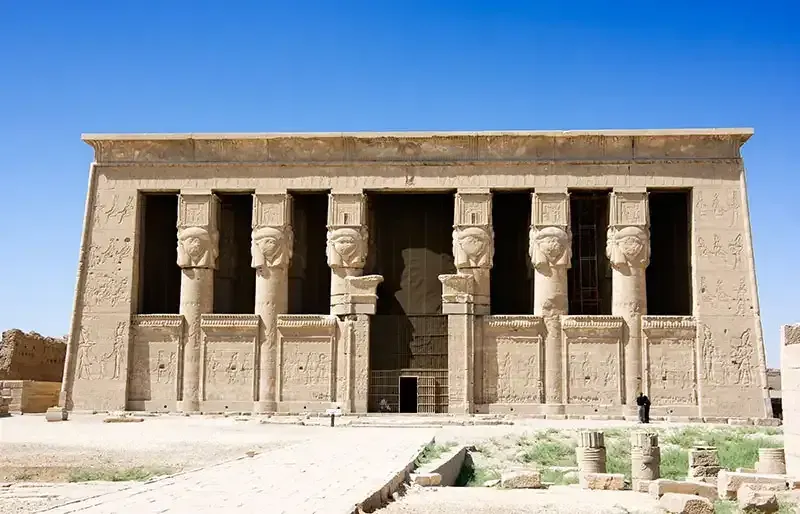
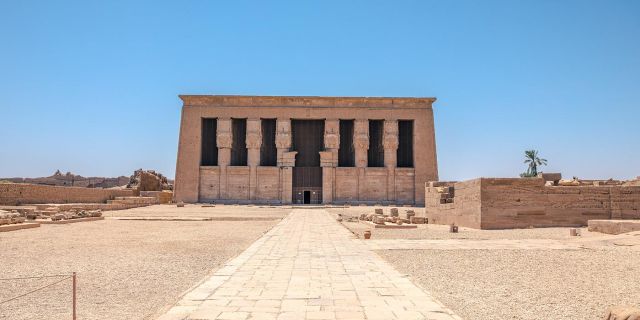
The Dendera Temple complex, dedicated primarily to Hathor — goddess of love, music, fertility, the sky, and motherhood — is the best-preserved Ptolemaic temple in Egypt. Where most ancient Egyptian temples survive as roofless shells of stripped walls, Dendera has its roof intact, its underground crypts accessible, its painted ceilings still bearing original colour after 2,000 years, and its complete ritual equipment still installed in the inner sanctuaries. To walk through Dendera is to experience, more completely than almost anywhere else in Egypt, what an ancient Egyptian temple actually felt like when it was alive.
Quick Facts: Dendera Temple Complex
| Dedicated to | Hathor — goddess of love, music, beauty, fertility, and the sky |
| Location | West bank of the Nile near Qena — 60 km north of Luxor, 4 km from the town of Dendera |
| Date of current temple | Main temple begun c. 54 BC (Ptolemy XII); completed under Roman emperors Augustus and Tiberius |
| Earlier structures on site | Evidence of temples dating to Pepi I (c. 2250 BC); 18th Dynasty temple confirmed |
| Main hypostyle hall | 18 Hathor-headed columns — the only hypostyle hall in Egypt with its roof and all columns intact |
| The Dendera Zodiac | Circular astronomical ceiling relief — original removed to Louvre in 1821; replica in situ |
| Underground crypts | 12 crypts in the walls and floor — some accessible to visitors, some not |
| Famous relief | Cleopatra VII and her son Caesarion — one of the largest surviving depictions of Cleopatra |
| Entrance fee (2026) | ~300 EGP (~$6 USD) — one of the best-value major sites in Egypt |
| Opening hours | Daily 08:00–17:00 |
| How to visit | Day trip from Luxor (~1 hr by car) · Some Nile cruises include it · Often combined with Abydos Temple |
| Permit required | Government road permit needed — arranged automatically by Egypt For Travel |
Hathor: The Goddess of Everything Beautiful
To understand why Dendera exists where it does and looks the way it does, you need to understand Hathor — one of the oldest and most widely worshipped deities in the entire Egyptian pantheon. Hathor was the goddess of love, beauty, music, dance, fertility, motherhood, and the sky. She was also, in her more terrifying aspect, the goddess of destruction — identified with the lioness-headed Sekhmet who, according to myth, nearly annihilated humanity before being tricked into drunkenness by the other gods.
Her most common iconographic form is a woman wearing a headdress of cow horns enclosing a sun disc — or simply a cow, or a woman with cow's ears. This bovine association is ancient and deliberate: the cow was the most important domestic animal in ancient Egypt, providing milk, labour, and meat, and Hathor embodied the same nurturing abundance. The Hathor column — a column with a Hathor face on each of its four sides, staring outward in all four directions — is one of the signature architectural features of Ptolemaic Egypt, and Dendera has eighteen of them in the main hypostyle hall alone.
Dendera was Hathor's principal cult centre — the place, in Egyptian religious geography, where she was most fully present, where her sacred barque (processional boat) rested between festivals, and where the most important annual ceremonies of her worship took place. The entire complex was designed as her house: a progression of spaces from the public outer courtyard through increasingly restricted inner halls to the innermost sanctuary, accessible only to the highest-ranking priests, where the goddess's cult statue lived.
What to See at Dendera: Room by Room
The Outer Hypostyle Hall
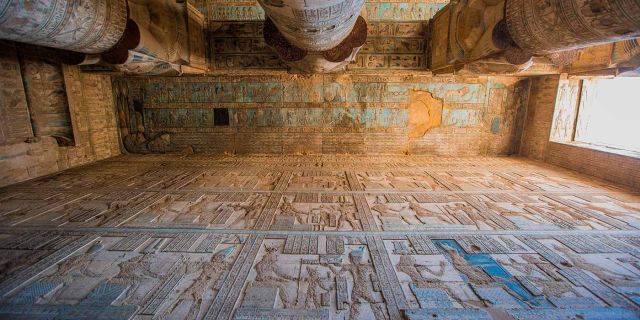
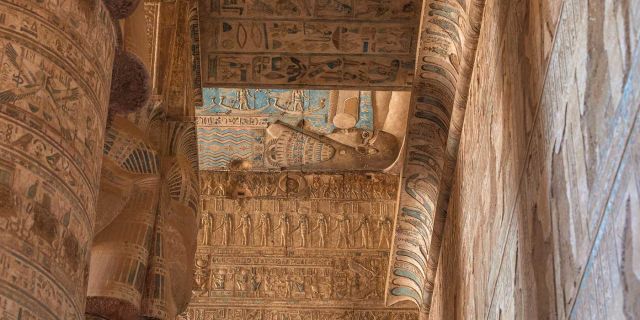
The temple's entrance leads into the outer hypostyle hall — a forest of 18 columns, each capped with a four-faced Hathor head gazing in all cardinal directions. This hall has its original roof intact, making it the most completely preserved columned hall in any Egyptian temple. The ceiling is covered in astronomical and religious reliefs, including depictions of the sky goddess Nut stretching across the full width of the ceiling, and the sun's daily journey. The painted colours on the ceiling — deep blues, vivid reds, warm ochres — survived 2,000 years because the hall was partly buried under desert sand, protecting it from both weathering and from the systematic defacement carried out by early Christians who destroyed many of the carved figures at eye level.
The Inner Hypostyle Hall and Inner Sanctuaries
Beyond the outer hall, a sequence of smaller halls and vestibules leads deeper into the temple. Each space is more restricted, more sacred, and more elaborately decorated than the last. The walls carry complete liturgical texts — hymns, offering lists, festival descriptions — carved in hieroglyphs so fine and densely packed that they cover virtually every square centimetre of stone. The innermost sanctuary, the naos, would originally have housed the golden cult statue of Hathor herself, accessible only to the high priest on specific ceremonial occasions.
The Roof and the New Year Chapel
A processional staircase — its walls carved with reliefs of priests carrying the sacred barque — leads from inside the temple to the roof. This rooftop was the site of one of the most important ceremonies in the Egyptian religious calendar: the New Year Festival, during which the statue of Hathor was carried to the roof and exposed to the rays of the rising sun, "uniting with the solar disc" in a ritual of divine rejuvenation. On the roof you will find two Osiris chapels — small chambers with elaborately carved and painted ceilings, including a replica of the famous Dendera Zodiac (the original circular astronomical ceiling was removed by French agents in 1821 and is now in the Louvre in Paris — the replica in situ gives you the correct visual context even if the stone is not original).
What no other guide tells you: The Dendera Zodiac is the only circular representation of the sky from ancient Egypt. Every other surviving Egyptian astronomical ceiling is rectangular. The circular form was a Greek innovation — reflecting the Ptolemaic dynasty's hybrid Greek-Egyptian identity — and the figures depicted include both traditional Egyptian constellations and Babylonian/Greek zodiac signs. It is, in effect, a snapshot of the ancient Mediterranean world's combined astronomical knowledge, carved in stone around 50 BC.
The Underground Crypts
Dendera's twelve underground crypts — narrow chambers built into the temple's walls and floor — are among the most extraordinary spaces in any Egyptian temple. Some are accessible to visitors; others remain sealed. The accessible crypts are entered through doorways so small that adults must crouch and turn sideways, descending into chambers barely a metre wide, their walls covered with carved reliefs of the sacred objects stored there: cult statues, ritual implements, precious stones. These were the temple's treasury and strong room, built into the fabric of the building itself to conceal the sacred objects from theft and profanation.
Among the carved reliefs in the crypts are the famous "Dendera light" images — elongated oval forms, often containing snake-like shapes, that have attracted fringe speculation about ancient electricity. The mainstream Egyptological interpretation is straightforward: these are representations of Harsomtus (a form of Horus as the uniting force of Upper and Lower Egypt) emerging from a lotus within the womb of the sky goddess Nut — standard Egyptian religious iconography, if unusually depicted in oval form. The debate is worth knowing about simply because your guide will likely be asked about it.
The Cleopatra Relief: Egypt's Most Famous Queen at Dendera
On the outer rear (south) wall of the temple — the wall facing away from the Nile — is one of the most significant historical reliefs in Egypt: a massive carved image of Cleopatra VII (the famous Cleopatra — the last pharaoh of Egypt, lover of Julius Caesar and Mark Antony) accompanied by her son Caesarion (Ptolemy XV Caesar — his father was Julius Caesar). The relief shows them in full Egyptian pharaonic style, performing offerings before the gods — a political statement of legitimacy that uses the ancient language of Egyptian kingship to assert the Ptolemaic dynasty's right to rule.
This is one of only a handful of authenticated contemporary portraits of Cleopatra anywhere in the world. The famous images on Roman coins give us her profile; the Dendera relief gives us her in full Egyptian royal regalia, larger than life, carved in stone. Caesarion — who was briefly co-ruler of Egypt before being murdered by Octavian (later Augustus) after his mother's suicide in 30 BC — appears beside her, the last of the Ptolemies. Standing before this wall, you are looking at the final chapter of three thousand years of pharaonic civilisation, carved in its own terms by the last people who had the right to do so.
Combining Dendera with Abydos
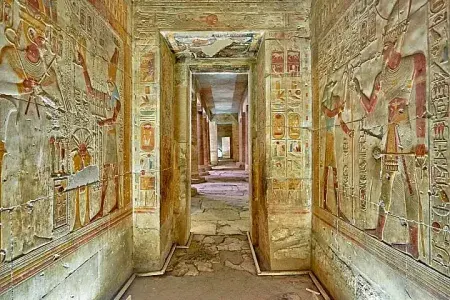
Dendera is almost always visited as part of a Dendera and Abydos day trip from Luxor — one of the most rewarding single days available to any traveller in Upper Egypt. Abydos, located approximately 60 km north of Dendera (and thus ~120 km from Luxor), is the cult centre of Osiris — the god of death and resurrection — and home to the Temple of Seti I, which contains the most refined and complete painted reliefs in any temple in Egypt. The two sites together — the Temple of Hathor at Dendera and the Temple of Osiris at Abydos — represent complementary aspects of Egyptian religious life: love, fertility, and the sky on one hand; death, resurrection, and the afterlife on the other.
Egypt For Travel's Dendera and Abydos day tour from Luxor covers both sites with a private Egyptologist guide and private vehicle, departing early morning and returning by late afternoon. A government road permit is required for this route and is arranged by Egypt For Travel as part of the booking.
| Feature | Dendera (Temple of Hathor) | Abydos (Temple of Seti I) |
|---|---|---|
| Deity | Hathor — goddess of love, sky, music | Osiris — god of death and resurrection |
| Period | Ptolemaic / Roman, c. 54 BC–100 AD | New Kingdom, c. 1290 BC (Seti I) |
| Condition | Roof intact; original colours partially preserved | Finest painted reliefs in any Egyptian temple |
| Unique feature | Dendera Zodiac; Cleopatra relief; accessible crypts | The Abydos King List — 76 pharaohs carved in sequence |
| Entrance fee | ~300 EGP (~$6) | ~260 EGP (~$5.5) |
| Distance from Luxor | ~60 km north (~1 hour) | ~120 km north (~1.5 hours) |
Practical Visitor Guide — Dendera Temple
| Detail | Information |
|---|---|
| Location | West bank of Nile near Qena; 60 km north of Luxor; 4 km from Dendera town |
| Entrance fee (2026) | ~300 EGP (~$6 USD) — covers the entire complex |
| Opening hours | Daily 08:00–17:00 |
| Time needed | 2–3 hours for the full complex including crypts and roof |
| Government permit | Required for the road to Dendera — arranged automatically by Egypt For Travel |
| Transport | Private car from Luxor (~1 hour each way); some Nile cruises moor at Qena and include as excursion |
| Best time to visit | Morning (08:00–11:00) — fewer visitors; good light inside the hypostyle hall |
| Combine with | Abydos Temple (same day, 60 km further north) — the classic Upper Egypt day trip |
| Photography | Excellent — original colours, intact roof, crypts; bring a torch for the underground chambers |
| Dress code | Modest clothing recommended; comfortable shoes essential (uneven floors, narrow passages) |
Frequently Asked Questions — Dendera Temple
Is Dendera Temple worth visiting?
Yes — emphatically. Dendera Temple is consistently rated by Egyptologists and experienced Egypt travellers as one of the most rewarding sites in the country. The combination of intact roof, original painted colours, accessible crypts, the Dendera Zodiac, and the Cleopatra relief makes it unique among Egyptian temples. The fact that it receives far fewer visitors than Karnak or the Valley of the Kings adds to its appeal.
What is the Dendera Zodiac?
The Dendera Zodiac is a circular astronomical ceiling relief, carved around 50 BC, that depicts the night sky including constellations and planets. It is the only circular representation of the heavens from ancient Egypt. The original was removed from the temple by French agents in 1821 and is now displayed in the Louvre in Paris. A high-quality replica is installed in situ. The Zodiac combines traditional Egyptian constellations with Babylonian and Greek zodiac signs — a product of the Ptolemaic dynasty's Greek-Egyptian cultural synthesis.
How far is Dendera Temple from Luxor?
Dendera Temple is approximately 60 kilometres north of Luxor, about a 1-hour drive by private car. A government road permit is required for the journey and is arranged by Egypt For Travel as part of the day tour booking.
Can I visit Dendera on a Nile cruise?
Some Nile cruises include Dendera as a shore excursion, mooring at Qena (the nearest town) and transporting passengers to the temple by vehicle. Not all standard cruise itineraries include it — check before booking if Dendera is a priority. Egypt For Travel can advise which cruise ships include this stop, or arrange it as a dedicated day tour from Luxor.
What is the "Dendera light" controversy?
The "Dendera light" refers to relief carvings in the temple's crypts depicting elongated oval forms with snake-like figures inside them. Some alternative history writers have claimed these represent ancient electric light bulbs. The mainstream Egyptological interpretation is that they depict Harsomtus (a form of the god Horus) emerging from a lotus within the womb of the sky goddess Nut — standard religious iconography. There is no evidence of ancient electricity; the carvings accompany hieroglyphic texts explaining their religious meaning in conventional terms.
Who was Hathor?
Hathor was one of the oldest and most widely worshipped goddesses in ancient Egypt — the deity of love, beauty, music, dance, fertility, motherhood, and the sky. She was depicted as a woman wearing cow horns enclosing a sun disc, or as a cow, or as a woman with cow's ears. In her destructive aspect she was identified with Sekhmet. Her principal cult centre was Dendera, where the annual New Year Festival involved carrying her statue to the temple roof to be reunited with the sun. She was also associated with the afterlife and was one of the deities who greeted the deceased in the Hall of Two Truths.
Visit Dendera Temple with Egypt For Travel on a private Dendera & Abydos day tour from Luxor — browse Luxor day tours. Private Egyptologist guide · All entrance fees · Government permit arranged · Private air-conditioned vehicle. WhatsApp: +20 155 555 2466. ETA Licence No. 1947.
.webp)