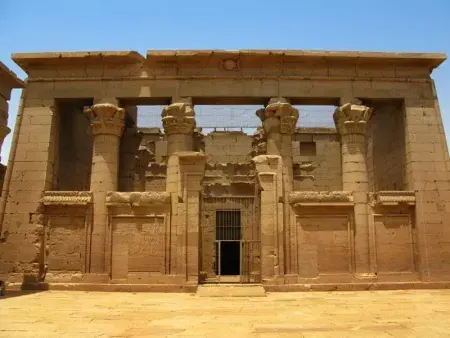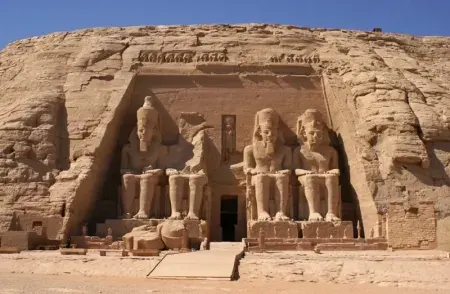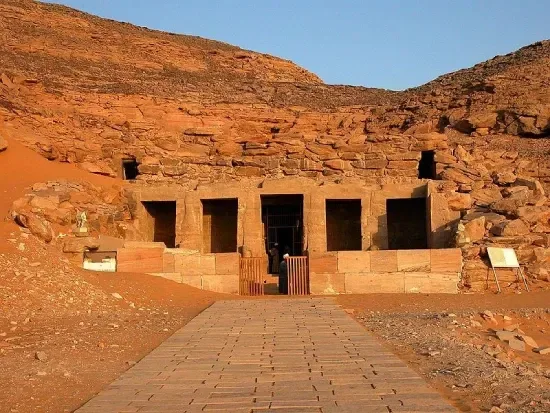
At the southern end of the standard Lake Nasser cruise itinerary, before the ships make their final run to Abu Simbel, they moor beside a low sandy bank and passengers disembark into a cluster of structures that looks modest from the outside. Amada Temple — the oldest temple on Lake Nasser, predating Abu Simbel by nearly 200 years — is one of the great small temples of ancient Egypt, and one of the least appreciated. The exterior is simple: a plain sandstone facade, a small forecourt, a sanctuary that fits comfortably inside a large family home. But the interior is extraordinary. The painted reliefs covering every wall of the Amada sanctuary are the finest preserved painted reliefs in any Nubian temple — brighter, more complete, and more detailed than anything at Abu Simbel, Kalabsha, or Wadi el-Seboua. Standing inside Amada is one of the purest experiences of intact New Kingdom religious art available anywhere in Egypt.
Quick Facts: Amada Temple
| Dedicated to | Amun-Ra and Ra-Horakhty — principal state gods of the New Kingdom |
| Builders | Thutmose III (begun c. 1450 BC) · Amenhotep II (continued) · Thutmose IV (hypostyle hall added) |
| Later modifications | Akhenaten defaced Amun's name (Amarna period) — restored by Seti I and Ramesses II |
| Why colours survive | Akhenaten's officials plastered over the walls — the plaster protected the paint beneath for 3,400 years |
| Historical Stele 1 | Year 3 of Amenhotep II — records execution of seven Asian princes, six hung on Thebes walls, one sent to Nubia as a warning |
| Historical Stele 2 | Year 4 of Merenptah — records defeat of Libyan invasion of Egypt (c. 1208 BC) |
| Original location | Ancient site of Amada — approximately 180 km south of Aswan |
| Relocation method | Unique — moved intact on a hydraulic platform (not dismantled) by French engineers, 1964–1975 |
| Adjacent sites | Temple of Derr (Ramesses II rock-cut) · Tomb of Pennut (rock-cut official's tomb) |
| UNESCO status | World Heritage Site — Nubian Monuments from Abu Simbel to Philae (1979) |
| Entrance fee (2026) | ~100 EGP (~$2 USD) — included in Lake Nasser cruise programmes |
Why Amada's Colours Survived: An Accidental Preservation
The extraordinary freshness of the painted reliefs inside Amada Temple is the result of a sequence of historical accidents. When the pharaoh Akhenaten (reigned c. 1353–1336 BC) launched his religious revolution — abolishing the traditional Egyptian pantheon and replacing it with the sole worship of the Aten (the sun disc) — his officials systematically defaced the name and image of Amun throughout Egypt's temples. At Amada, they went further: they plastered over the painted walls of the entire sanctuary, concealing the relief decoration completely.
After Akhenaten's death and the subsequent restoration of traditional religion under Tutankhamun and Seti I, the plaster at Amada was left in place. No one removed it and repainted the walls — which would have been the standard procedure elsewhere. Instead, the plaster remained, sealing the original 15th-century BC painted reliefs in an almost airtight environment for the next 3,400 years. When French archaeologists removed the Akhenaten-era plaster during conservation work in the 20th century, they found the paint beneath in a state of extraordinary preservation — colours that had not seen light since approximately 1350 BC, as vivid as when they were first applied.
What no other guide tells you: Akhenaten's erasure of Amun's name was so thorough at Amada that even the word amun within compound royal names was chiselled out — including from the cartouche of Amenhotep III (whose name contains Amun) in the very temple his grandson had inherited and was nominally maintaining. The restoration under Seti I carefully refilled these erasures, but the chisel marks are still visible beside the filled areas if you look closely at the cartouches on the walls.

The Two Historical Stelae: Documents Carved in Stone
Amada Temple contains two inscribed stelae of unique historical importance — primary source documents for events that are otherwise poorly attested.
The Stele of Amenhotep II (Year 3)
Carved in the third year of Amenhotep II's reign (c. 1425 BC), this stele records the pharaoh's military campaign in Syria and the Levant in unusually direct language. The text describes the capture of seven Asian princes — rulers or officials of cities in the region of modern Syria — who were brought back to Egypt as prisoners. Six were hanged on the walls of Thebes; the seventh was transported to Nubia and hung on the walls of the Nubian capital as a demonstration of Egyptian power directed specifically at the Nubian population. The stele was carved at Amada precisely because of its Nubian audience: its message was intended to deter any thought of Nubian rebellion by displaying the fate of those who opposed Egypt. The graphic directness of the text — unusual even by the standards of pharaonic military rhetoric — makes it one of the most cited New Kingdom historical documents.
The Stele of Merenptah (Year 4)
The second stele, carved in the fourth year of Merenptah's reign (c. 1208 BC), records the pharaoh's defeat of a major Libyan invasion of Egypt. The Libyan coalition — led by a chieftain named Meryey — attempted to settle in the Nile Delta with their families and possessions, suggesting a migration driven by climate pressure as much as military ambition. Merenptah defeated them in a major battle, and the stele records the Egyptian victory in detail including casualty figures and lists of captured weapons and livestock. This inscription is closely related to the famous Merenptah Stele in Cairo (which contains the only reference to "Israel" in any ancient Egyptian text) — both record events of the same campaign year, providing complementary accounts of the same historical moment from different angles.
The Temple of Derr and the Tomb of Pennut
Adjacent to Amada Temple at the same lakeside location are two further relocated structures that are included in the same site visit.
The Temple of Derr is a rock-cut temple of Ramesses II, originally located at ancient Derr approximately 11 km south of Amada. Like the Abu Simbel temples, it was carved directly into a cliff face and dedicated to Ra-Horakhty and the deified Ramesses II. The interior reliefs — Ramesses II in battle, Ramesses II before the gods — are characteristic of the pharaoh's Nubian building programme, though less well-preserved than Abu Simbel's. The temple was moved intact in the 1960s and reassembled at New Amada.
The Tomb of Pennut is the rock-cut tomb of a high official named Pennut who served as deputy of Wawat (the Egyptian administrative term for Lower Nubia) during the reign of Ramesses VI (c. 1143 BC). The painted scenes inside are remarkable for depicting Pennut receiving honours directly from Ramesses VI — a scene of the pharaoh rewarding a provincial official that is rarely found in tomb decoration and gives an intimate glimpse of the relationship between the New Kingdom state and its Nubian administrators.
How Amada Was Moved: A Unique Engineering Solution
While most Nubian temples were dismantled block by block during the UNESCO rescue campaign, Amada Temple was moved by an entirely different method — one that has never been replicated before or since. French engineers, concerned that dismantling the temple would damage the fragile painted plaster still adhering to many of its surfaces, devised a plan to move the entire temple structure intact.
They built a hydraulic platform — essentially a sophisticated wheeled cradle — beneath the foundations of the temple, and then slowly rolled the entire 800-tonne structure across the desert floor to its new location, approximately 2.5 km from the original site. The operation took from 1964 to 1975 — eleven years from planning to completion — and moved the temple at an average speed of approximately 25 metres per day. It remains the only ancient Egyptian temple ever moved in one piece.
Practical Visitor Guide — Amada Temple
| Detail | Information |
|---|---|
| Access | By Lake Nasser cruise (Day 3–4 from Aswan, after Wadi el-Seboua, before Abu Simbel) |
| Time needed | 2–3 hours covers Amada Temple + Temple of Derr + Tomb of Pennut |
| Don't miss | The painted sanctuary interior · The Amenhotep II stele · The Merenptah stele · Temple of Derr reliefs |
| Photography | Interior photography allowed — the painted colours are exceptional; no flash to protect pigments |
| Crowds | Minimal — you will typically share the site only with passengers from your own cruise ship |
| Entrance fee (2026) | ~100 EGP (~$2 USD) — included in Lake Nasser cruise programmes |
Frequently Asked Questions — Amada Temple
Why are Amada Temple's paintings so well preserved?
The painted reliefs at Amada survived because Akhenaten's officials plastered over them during the Amarna period (c. 1353–1336 BC), sealing the original 15th-century BC paint in a protected environment for over 3,000 years. When French conservators removed the Akhenaten-era plaster in the 20th century, they found the paint beneath in extraordinary condition — among the freshest surviving New Kingdom painted surfaces in Egypt.
Who built Amada Temple?
Construction was begun by Thutmose III around 1450 BC and continued by his son Amenhotep II, who added a hypostyle hall. Further modifications were made by Thutmose IV. The temple was later defaced by Akhenaten and restored by Seti I and Ramesses II.
How was Amada Temple moved to its current location?
Unlike most other Nubian temples, Amada was not dismantled block by block. French engineers moved it intact on a hydraulic platform, rolling the entire 800-tonne structure approximately 2.5 km across the desert to its current site over a period of eleven years (1964–1975). It is the only ancient Egyptian temple ever moved in one piece.
What are the two stelae at Amada Temple?
The first stele records Amenhotep II's Year 3 military campaign in Syria, including the execution of seven Asian princes. The second records Merenptah's Year 4 defeat of the Libyan invasion of Egypt (c. 1208 BC). Both are primary historical documents of significant importance to Egyptologists.
Can I visit Amada Temple without a Lake Nasser cruise?
The site is accessible by road but is approximately 180 km south of Aswan on a remote desert track. The vast majority of visitors arrive by Lake Nasser cruise, which remains the most practical and rewarding approach. Egypt For Travel's Lake Nasser cruise packages include Amada as a standard stop on Day 3 or 4 of the itinerary.
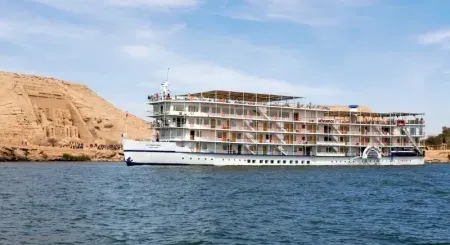
Visit Amada Temple as part of a Lake Nasser cruise with Egypt For Travel — Lake Nasser cruises from $1,500 per person, visiting Kalabsha, Wadi el-Seboua, Amada & Abu Simbel over 4 nights. All meals · Private Egyptologist guide · All entrance fees. WhatsApp: +20 155 555 2466. ETA Licence No. 1947.

.webp)