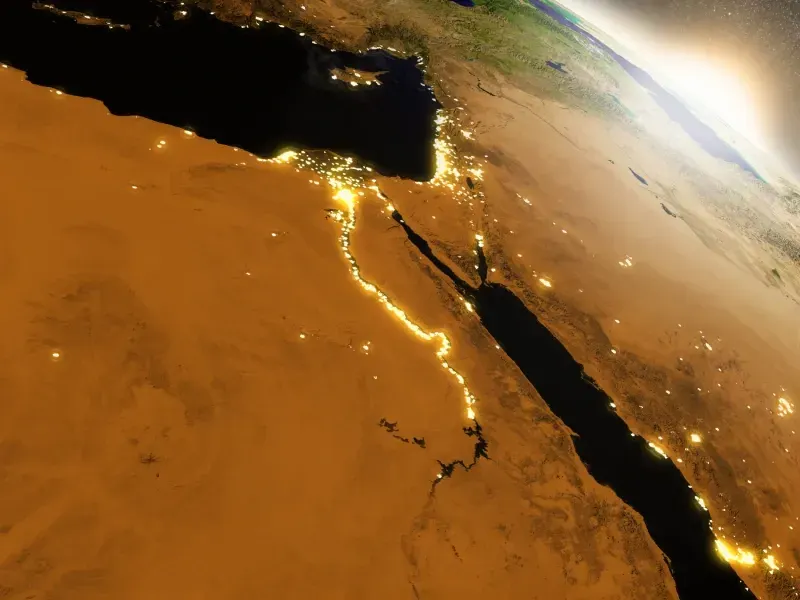
Egypt occupies a geographical position that has shaped human history for millennia. Straddling the north-eastern corner of Africa and the Sinai Peninsula of Asia, it sits at the crossroads of three continents — the bridge between Africa, Asia, and the Mediterranean world of Europe. The Nile River — the world's longest — flows from south to north through the heart of the country, creating the narrow strip of fertile land that sustained one of history's greatest civilisations for over 3,000 years. Beyond the Nile Valley, 94% of Egypt's land area is desert — the Sahara to the west, the Eastern Desert between the Nile and the Red Sea, and the Sinai Peninsula's rugged mountains to the north-east.
Egypt at a Glance — Essential Facts
| Official name | Arab Republic of Egypt (Jumhuriyyat Misr al-Arabiyya) |
| Capital | Cairo — population ~22 million in greater metro area (largest city in Africa) |
| Population | Over 105 million (2025) — one of Africa's most populous nations |
| Area | 1,001,450 km² — approximately the size of France, Spain, and Germany combined |
| Official language | Arabic (Egyptian Arabic is the most widely spoken Arabic dialect in the world) |
| Religion | Islam ~90% (predominantly Sunni) · Coptic Christianity ~10% |
| Currency | Egyptian Pound (EGP) — approx. 50 EGP = $1 USD (2025–26 rate, fluctuates) |
| Time zone | Eastern European Time (EET) — UTC+2 · Summer: EEST UTC+3 |
| Electricity | 220V · 50Hz · European-style round 2-pin plugs (Type C/F) |
| International dialling | +20 |
| Visa for most nationalities | $25 on arrival or e-visa — see our visa guide |
| Tourists (2025) | 18 million — highest since 2010 |
| Main international airports | Cairo International (CAI) · Hurghada (HRG) · Sharm el-Sheikh (SSH) · Luxor (LXE) · Aswan (ASW) |
| ETA Tour Licence | Egypt For Travel — Category A, Licence No. 1947 |
Egypt's Geography: Five Distinct Landscapes
Egypt's geography is far more varied than its reputation as a "desert country" suggests. The country contains five distinct landscape zones, each with its own character, ecology, and tourism offering.
| Region | Character | Key Destinations |
|---|---|---|
| Nile Valley | Narrow fertile strip from Aswan to Cairo — 94% of Egyptians live here | Cairo · Luxor · Aswan · Abu Simbel · all ancient temples |
| Nile Delta | Fan-shaped fertile plain at the Mediterranean — most productive farmland | Alexandria · Rosetta · ancient Tanis and Sais |
| Western Desert | Vast Saharan desert with oases — covers 68% of Egypt's land area | Siwa Oasis · Bahariya · White Desert · Farafra |
| Eastern Desert & Red Sea | Rocky desert between Nile and Red Sea — 1,500 km of coastline | Hurghada · Marsa Alam · Safaga · El Gouna |
| Sinai Peninsula | Mountain desert between the Red Sea gulfs — Bedouin heartland | Sharm el-Sheikh · Dahab · Saint Catherine · Colored Canyon |
Egypt's History: 7,000 Years in Brief
Egypt's recorded history is the longest of any continuously inhabited nation-state on Earth. From the predynastic settlements of the Nile Valley (c. 5000 BC) through the pharaonic dynasties (3100–30 BC), the Greek Ptolemaic period (332–30 BC), Roman rule (30 BC–395 AD), Byzantine and early Christian Egypt (395–641 AD), Arab conquest and Islamic Egypt (641 AD onward), Ottoman rule (1517–1798), French and then British intervention in the modern era, to independence in 1922 and the republic established in 1953 — Egypt's historical depth is without parallel.
The monuments left by this history are what draw 18 million visitors per year. The Giza Pyramids (c. 2560 BC) are the only surviving Wonder of the Ancient World. The Grand Egyptian Museum (opened November 2025) houses the world's largest collection of ancient artefacts. The temples of Karnak and Luxor, the Valley of the Kings, and the temples of Abu Simbel represent the full arc of one of history's greatest civilisations, accessible within a single two-week itinerary.
Practical Information for Visitors
| Topic | Information |
|---|---|
| Visa | $25 on arrival for most nationalities · E-visa available · Sinai-only stamp free at Sharm airport |
| Currency | Egyptian Pound (EGP) · ATMs widely available in cities · USD/EUR accepted at major hotels |
| Best time to visit | October–April (cool season) · Avoid June–August (extreme heat in Luxor/Aswan) · Ramadan 2026: ~17 Feb |
| Language | Arabic official · English widely spoken in tourist areas · French common in some regions |
| Dress code | Conservative in mosques and religious sites · Beachwear acceptable at Red Sea resorts · Shoulders/knees covered for temples |
| Tipping | Guide $10–15/day · Driver $5–8/day · Cruise crew $10–12/night collective |
| Water | Drink bottled water only · Tap water safe for brushing teeth in hotels |
| Internet | 4G widely available · SIM cards cheap at airport · Hotel WiFi generally reliable |
Frequently Asked Questions — Egypt Country
Is Egypt in Africa or the Middle East?
Egypt is geographically in north-eastern Africa — the vast majority of its land area (including the Nile Valley, Nile Delta, and Western Desert) is on the African continent. The Sinai Peninsula is technically part of Asia. Politically and culturally, Egypt is a member of the Arab League and the African Union, identifying with both regions. It is the only African country with territory on two continents.
What is Egypt's capital city?
Cairo is Egypt's capital and largest city, with a greater metropolitan population of approximately 22 million people — making it the largest city in Africa and the Arab world. It is home to the Giza Pyramids, the Grand Egyptian Museum (opened November 2025), Khan El-Khalili bazaar, and Islamic Cairo.
What language is spoken in Egypt?
The official language is Arabic — specifically Egyptian Arabic, the most widely spoken dialect in the Arab world (partly because Egyptian cinema and television have spread it across the region). English is widely spoken in tourist areas, hotels, and by educated Egyptians. The Coptic language — a direct descendant of ancient Egyptian — is still used in Coptic Christian religious services.
What currency does Egypt use?
Egypt uses the Egyptian Pound (EGP). The exchange rate fluctuates — in 2025–26 approximately 50 EGP = $1 USD. ATMs are widely available in cities and tourist areas. USD and EUR are accepted at major hotels and some tourist sites, but Egyptian pounds are needed for most local transactions.
How many tourists visit Egypt each year?
Egypt received 18 million international tourists in 2025 — the highest number since 2010 and a significant recovery from the disruptions of 2011–2019. Tourism is one of Egypt's largest industries, contributing approximately 12% of GDP.
Plan your Egypt visit with Egypt For Travel — browse Egypt tour packages from $749 per person. Category A licensed operator · Private Egyptologist guides · All regions of Egypt covered. WhatsApp: +20 155 555 2466. ETA Licence No. 1947.