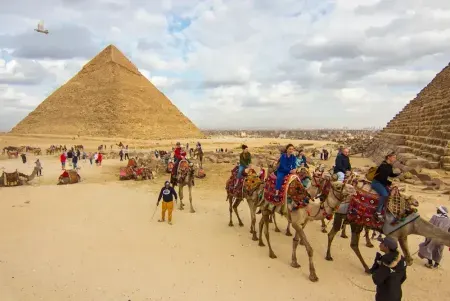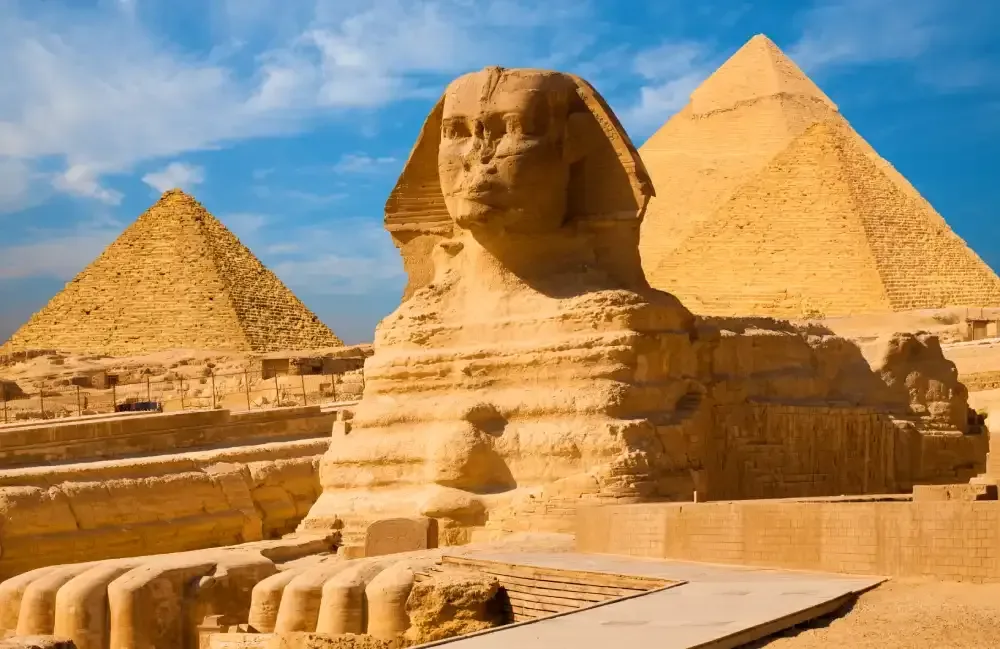
The Great Sphinx of Giza is the largest monolithic sculpture in the world and one of the oldest known large-scale statues on earth. Carved from a single natural limestone outcrop on the Giza Plateau, it measures 73 metres long (as long as a city block) and 20 metres high (as tall as a six-storey building). It faces due east — directly towards the rising sun at the spring and autumn equinoxes. The face is believed to represent Pharaoh Khafre. The body is that of a recumbent lion. Together, they form the most recognisable single image in the history of ancient Egypt — and one of the most immediately powerful things you will stand in front of in your life.
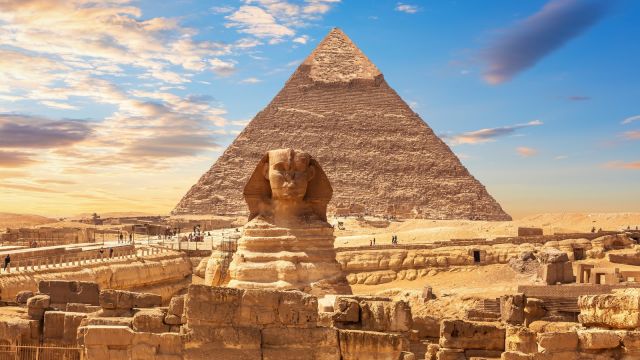
Great Sphinx of Giza 2026 — Complete Visitor Guide
Quick Facts
| Location | Giza Plateau, 13km southwest of Cairo — inside the main Pyramids complex |
| Dimensions | 73m long · 20m high · Face: 5m wide · Carved from a single limestone outcrop |
| Built | ~2500 BC under Pharaoh Khafre (4th Dynasty) — alongside his pyramid |
| Entrance Fee | Included in Giza Pyramids complex ticket (700 EGP ~$14) — no separate charge |
| Faces | Due East — aligned with the sunrise at the spring and autumn equinoxes |
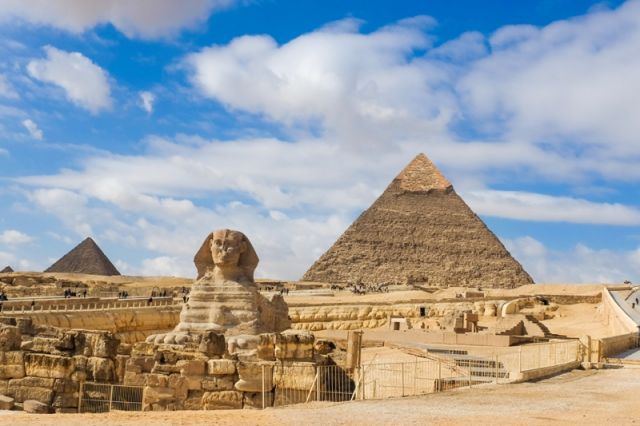
| Best Photo Spot | Southeast — shows Sphinx full profile with Pyramid of Khafre directly behind |
| Opening Hours | Same as Giza complex: 7:00 AM – 5:00 PM (peak season 7:00 PM) |
The Missing Nose — The Real Story
The most frequently asked question about the Sphinx is: who shot off the nose? The popular myth is Napoleon’s soldiers used it for cannon target practice. This is false — and demonstrably so. Drawings made by European travelers in the 15th century already show the Sphinx without a nose, two centuries before Napoleon’s 1798 Egyptian campaign. The actual cause, recorded in historical sources, is Muhammad Sa’im al-Dahr — a Sufi religious leader who, in 1378 AD, ordered the nose damaged as a religious statement against the idol worship he believed the local population was directing at the statue. The nose was not shot off by cannon fire. It was deliberately removed with chisels over six centuries ago as an act of religious iconoclasm.
The Dream Stele — How the Sphinx Was Rescued
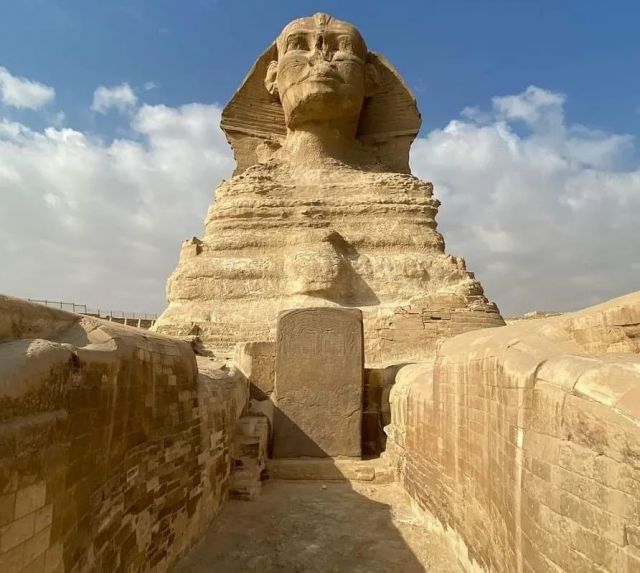
Between the front paws of the Sphinx stands a granite Dream Stele erected by Pharaoh Thutmose IV around 1400 BC. The text records a dream in which the young prince Thutmose, asleep in the shadow of the Sphinx during a hunting trip, was visited by the god Harmakhis-Khepri-Ra-Atum (the Sphinx as divine manifestation) who promised him the throne of Egypt if he cleared the sand that had buried the Sphinx to the neck. Thutmose cleared the sand, became pharaoh, and erected this stele to commemorate the event. The stele is the first documented evidence that the Sphinx was already ancient, partially buried, and in need of restoration 3,400 years ago — one of the earliest recorded instances of archaeological conservation in human history.
The Best Photography Spot for the Sphinx
The photograph most visitors want — Sphinx in the foreground, Pyramid of Khafre directly behind — is taken from the southeast, at the level of the Sphinx’s enclosure. This angle aligns the Sphinx’s profile precisely with the south face of the Pyramid of Khafre. Early morning gives the best light on the Sphinx’s face (lit from the east). Late afternoon gives the most dramatic sky behind the pyramid. Midday produces harsh shadows and flat light. Your Egyptologist guide knows exactly where to position you for this shot.
Practical Tips for Visiting the Sphinx in 2026
- Entrance is included in the Pyramids complex ticket (700 EGP): No separate ticket is needed for the Sphinx. It is within the main Giza plateau complex.
- Walk down into the Sphinx enclosure: Most visitors photograph the Sphinx from the edge of the enclosure above. Walking down into the enclosure and standing at the level of the Sphinx’s base gives a completely different and more powerful sense of scale.
- Combine with the Valley Temple: Adjacent to the Sphinx is the Valley Temple of Khafre — one of the oldest stone buildings in the world (2500 BC), built from massive monolithic granite blocks. Most visitors walk past it. Your guide will take you inside.
- Allow 45–60 minutes: Sphinx + Valley Temple + photography at optimal spots = approximately 45–60 minutes. This fits naturally into the morning Giza visit after the Pyramids.
Frequently Asked Questions About the Sphinx
How old is the Great Sphinx?
The Great Sphinx of Giza is approximately 4,500 years old, built during the reign of Pharaoh Khafre around 2500 BC. This makes it roughly contemporary with the Pyramid of Khafre and slightly later than the Great Pyramid of Khufu. There is a persistent alternative theory, promoted by some non-Egyptologists, that the Sphinx is much older (10,000+ years) based on water erosion patterns. The mainstream Egyptological consensus, supported by the archaeological and historical record, dates the Sphinx firmly to the 4th Dynasty reign of Khafre.
Who does the Sphinx represent?
The face of the Great Sphinx is most widely believed to represent Pharaoh Khafre — on the basis that the Sphinx is positioned adjacent to Khafre’s pyramid and Valley Temple, that stylistic analysis of the face aligns with 4th Dynasty royal portraiture, and that the Sphinx enclosure was part of Khafre’s funerary complex. Some Egyptologists have proposed it represents Khufu (builder of the Great Pyramid), but this minority view has not gained widespread acceptance. The question remains technically open — no inscription directly names the Sphinx as Khafre, which is unusual for an Egyptian royal monument of this scale.
Visit the Sphinx with Egypt For Travel — private Egyptologist guide, private vehicle, all entrance fees included. Combined with Pyramids and Grand Egyptian Museum in one Cairo day. Tour to Pyramids, Memphis & Saqqara ($60) or WhatsApp: +20 155 555 2466.