There is a moment, usually on the first morning of a Nile cruise, when Egypt stops being a collection of famous sites and becomes something else entirely — a living landscape shaped over millennia by a single river. The Nile is never not present in Egypt. From the air, you see it immediately: a thin green ribbon threading through an ocean of pale desert, the farmland clinging to both banks in a strip rarely more than a few kilometres wide before the sand takes over completely. Every temple, every tomb, every pyramid, every city of consequence in ancient and modern Egypt was built within reach of this water. The Nile did not merely support Egyptian civilisation — it was Egyptian civilisation.
The ancient Egyptians called it simply Iteru — "The River" — as though no other river in the world needed naming. They were not wrong. For a traveller in Egypt today, understanding the Nile is not an optional extra. It is the key to understanding everything else you will see.
Nile River — Key Facts
| Total length | 6,650 km (4,130 miles) — longest river in the world |
| Countries crossed | 11 — Tanzania, Uganda, Rwanda, Burundi, DR Congo, Kenya, Ethiopia, Eritrea, South Sudan, Sudan, Egypt |
| Two main tributaries | White Nile (source: Lake Victoria, Uganda) + Blue Nile (source: Lake Tana, Ethiopia) |
| Where tributaries meet | Khartoum, Sudan — the confluence is visible from the air |
| Nile in Egypt | ~1,545 km from Sudan border to Mediterranean Sea — flows entirely north |
| The Nile Delta | Fans out across ~240 km at the Mediterranean — one of the largest river deltas on Earth |
| Ancient name | Iteru (ancient Egyptian) — simply "The River" |
| Population supported | Over 95% of Egypt's 105 million people live within a few kilometres of the Nile |
| Annual flood (historical) | June–September — ended after construction of Aswan High Dam (1970) |
| Aswan High Dam | Completed 1970 — created Lake Nasser (500 km long), ended annual flooding, transformed Egyptian agriculture |
| Tourist cruise route | Luxor to Aswan (or reverse) — 4 nights standard; 7–8 nights dahabiya |
| Lake Nasser cruise route | Aswan to Abu Simbel (or reverse) — 4 nights on Lake Nasser |
The White Nile and the Blue Nile: Two Rivers, One Legend
The Nile is not a single river but the product of two major tributaries with entirely different characters, origins, and contributions. Understanding both makes the whole river make sense.
The White Nile rises from Lake Victoria in Uganda — the largest lake in Africa and the second-largest freshwater lake in the world — and flows north through South Sudan, where it passes through the vast Sudd swamp (one of the largest wetlands on Earth) before entering Sudan and meeting the Blue Nile at Khartoum. The White Nile is the longer of the two tributaries and provides a steady, year-round flow of water, but carries relatively little sediment. It is the backbone of the river — reliable but not dramatic.
The Blue Nile rises from Lake Tana in the Ethiopian Highlands and flows in a great arc through Ethiopia before entering Sudan from the south-east. It is shorter than the White Nile but — crucially — it carries the majority of the river's water volume and nearly all of its silt load. During the Ethiopian rainy season (June–September), the Blue Nile swells enormously, sending a torrent of water and nutrient-rich volcanic soil northward into Egypt. This was the annual flood — the Inundation — that the ancient Egyptians built their entire agricultural system around, and that made Egypt the most productive farming land in the ancient world.
What no other guide tells you: The ancient Egyptians had no idea where the Nile flood came from. They knew it arrived every year from the south, they knew it brought the black silt that made their fields fertile, and they attributed it to the god Hapy — a blue or green androgynous deity depicted with pendulous breasts (representing fertility) and a headdress of papyrus plants. Hapy lived, they believed, in a cavern beneath the First Cataract at Aswan, and released the flood each year. They were observing the correct geographical location for the beginning of the Egyptian Nile, even if the theological explanation was different from the hydrological one.

The Annual Flood: How the Nile Made Egypt Possible
For over 5,000 years — from the earliest predynastic settlements through to 1970 AD when the Aswan High Dam was completed — the entire Egyptian agricultural system was built around a single annual event: the flooding of the Nile. Each year, between June and September, the river rose dramatically as the Blue Nile surge from Ethiopia arrived. At its peak, the Nile could rise 8 metres or more above its low-water level in some areas, inundating the flat farmland on both sides of the river with a shallow sheet of water. When the water retreated, it left behind a layer of dark, mineral-rich silt — called kemet in ancient Egyptian, meaning "the black land" — which is also the origin of the ancient name for Egypt itself.
This silt was extraordinarily fertile. A single inundation deposited enough nutrients to sustain crops for an entire year without any need for additional fertilisation. The ancient Egyptians planted wheat, barley, flax, and vegetables in the wet silt as soon as the waters receded in October, harvested in February or March, and used the dry summer months (when the river was at its lowest and the fields were baked hard) for quarrying stone, building monuments, and military campaigns. The entire rhythm of Egyptian civilisation — its calendar, its tax system, its religion, its art — was keyed to the rhythm of the river.
The ancient Egyptians measured the flood level using structures called Nilometers — calibrated wells or staircases cut into the riverbank or into island bedrock, allowing officials to read the water level precisely. Two Nilometers survive in Egypt today: one on Rhoda Island in Cairo (built 861 AD, the best-preserved Islamic-era Nilometer in Egypt) and one on Elephantine Island in Aswan (ancient, rebuilt multiple times). A flood that was too low meant famine; a flood that was too high meant catastrophic destruction of villages and dykes. The ideal flood was measured precisely, and the tax rates for that year's harvest were set accordingly.
The Nile in Ancient Egyptian Religion
No river in human history has been more thoroughly woven into a civilisation's spiritual life than the Nile was woven into Egypt's. The Egyptians did not simply depend on the Nile — they understood it as a divine system, every aspect of which was governed by gods and reflected cosmic truths.
The god Hapy personified the inundation itself — the annual gift of water and silt. Osiris, god of death and resurrection, was associated with the Nile's cyclical flooding and receding: his death and dismemberment by Set, and his resurrection by Isis, mirrored the death of the dry season and the rebirth of fertility with each new flood. The colour of the Nile — blue-green in its main body, black with silt at flood time — appears throughout Egyptian art as the skin colour of gods associated with fertility and regeneration: Osiris is painted green or black; Hapy is blue or green; even the god Amun wears a blue headdress.
The Egyptians divided their world into two lands defined by the Nile: Kemet (the Black Land — the fertile Nile Valley and Delta, the cultivated world of Egypt) and Deshret (the Red Land — the desert beyond, the realm of chaos, danger, and foreigners). The boundary between the two was razor-sharp and visible from the ground: one step on black soil, one step on red sand, the transition so abrupt you could straddle it with one foot on each. This binary — fertility and death, order and chaos, life and the void — runs through all of Egyptian thought, and it begins at the Nile's edge.
The Six Cataracts: Natural Barriers That Shaped History
Along its course through Sudan and southern Egypt, the Nile is interrupted by six cataracts — sections of shallow, rocky rapids where the river flows over granite outcrops, making navigation impossible for most boats. These cataracts were not just geographical features; they were political and military boundaries that shaped the history of Egypt and Nubia for 3,000 years.
| Cataract | Location | Historical Significance |
|---|---|---|
| First Cataract | Aswan, Egypt | Southern boundary of ancient Egypt for most of its history; site of Philae Temple and the Unfinished Obelisk; now submerged under Lake Nasser |
| Second Cataract | Wadi Halfa, Sudan/Egypt border | Egyptian fortress boundary during the New Kingdom; now submerged under Lake Nasser |
| Third Cataract | Kerma, Sudan | Capital of the Kingdom of Kerma — Egypt's great Nubian rival during the Middle Kingdom |
| Fourth Cataract | Meroe region, Sudan | Heart of the Kingdom of Meroe — the Nubian civilisation that survived Egypt and outlasted it |
| Fifth & Sixth Cataracts | Central Sudan | Marked the extent of Egyptian imperial ambition in Nubia during the New Kingdom |
The First Cataract at Aswan is the one that matters most to travellers in Egypt today. For most of ancient Egyptian history it marked the southern border of Egypt proper — the point beyond which lay Nubia, a foreign land that Egypt simultaneously traded with, conquered, and feared. The temples of Philae and Abu Simbel both sit at or near this ancient frontier, their scale and elaboration partly explained by their role as statements of Egyptian power directed at the Nubian world beyond.

Experiencing the Nile: Your Options as a Traveller
For travellers in Egypt today, the Nile offers several completely different experiences — from the large-scale comfort of a standard cruise ship to the intimate pace of a traditional sailing vessel. Here is an honest guide to each option.
| Experience | What It Is | Best For | Price From |
|---|---|---|---|
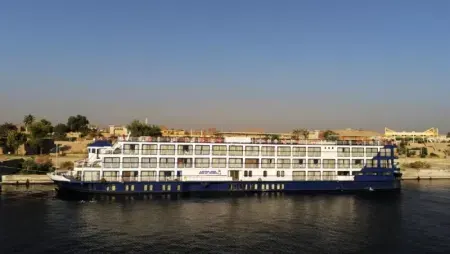
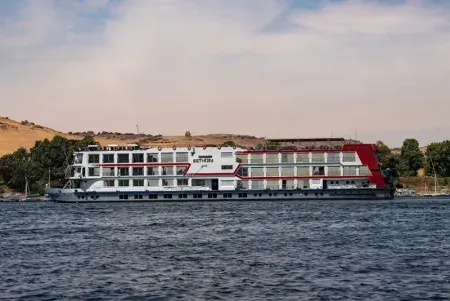
| Standard Nile Cruise | Motor cruise ship, 60–90 cabins, pool deck, restaurant, bar — 4 nights Luxor to Aswan visiting Karnak, Valley of the Kings, Edfu, Kom Ombo, Philae | First-time visitors; families; those wanting to cover the key sites efficiently | From $539 per person |
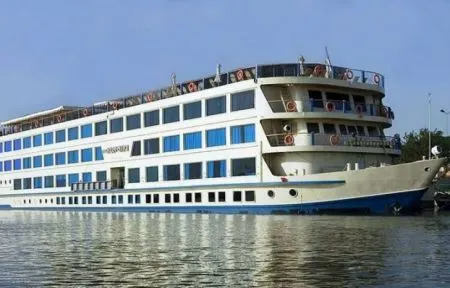
| Luxury Nile Cruise | 5-star cruise ships (Steigenberger, Movenpick, Sonesta) — larger cabins, superior restaurants, spa, private guides | Couples; honeymoons; travellers who want premium service | From $699 per person |
| Dahabiya Cruise | Traditional Egyptian wooden sailing vessel — 8–16 passengers maximum, 7–8 nights, under sail between temple stops, unhurried pace | Repeat visitors; travellers wanting an intimate, unhurried experience; photography enthusiasts | From $1,400 per person |
| Lake Nasser Cruise | Cruise on the man-made lake south of Aswan — visits temples relocated from rising Nasser waters: Abu Simbel, Kalabsha, Wadi el-Seboua, Amada | History enthusiasts; those who have already done the standard Nile cruise | From $1,500 per person |
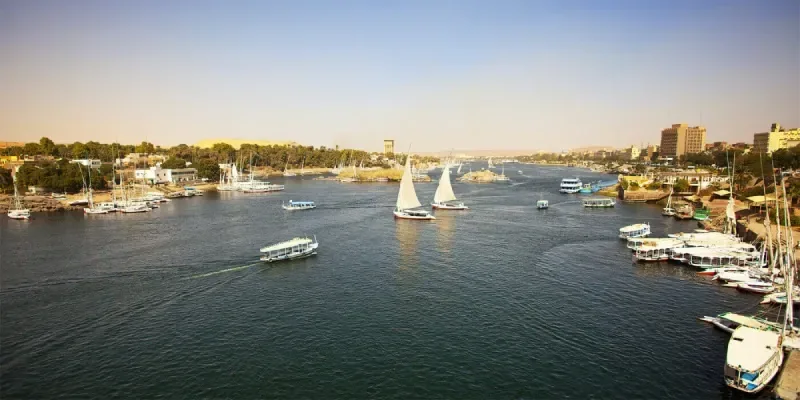
| Felucca Ride | Traditional wooden sailboat — 1–3 hours on the Nile at sunrise or sunset; no engine, just wind and oar | Anyone — a perfect 2-hour add-on to any Aswan or Luxor visit | ~$15–30 per boat |
| Nile Corniche Walk | The riverside promenade in Aswan, Luxor, or Cairo — free, best at dusk when the cruise ships light up and the breeze comes off the water | Everyone — no booking required | Free |
The Classic Nile Cruise Route: Luxor to Aswan
The standard tourist Nile cruise covers the 225 km stretch of river between Luxor and Aswan, navigating south against the current (or north with it, depending on departure point) over four nights. This section of the Nile is the most historically rich river corridor in the world: every bend reveals a temple, tomb, quarry site, or ancient city. The temples visited on a standard cruise — Karnak, Edfu, Kom Ombo, Philae — represent some of the best-preserved ancient monuments in Egypt.
| Night | Location | Sites Visited |
|---|---|---|
| Night 1 | Luxor (embarkation) | Karnak Temple + Luxor Temple evening visit |
| Night 2 | West Bank, Luxor | Valley of the Kings + Hatshepsut Temple + Colossi of Memnon · Sail south |
| Night 3 | Edfu | Temple of Horus at Edfu (best-preserved temple in Egypt) · Sail to Kom Ombo |
| Night 4 | Kom Ombo / Aswan | Kom Ombo double temple at sunset · Sail to Aswan |
| Day 5 | Aswan (disembarkation) | Philae Temple + High Dam + Unfinished Obelisk · Optional Abu Simbel day trip |
Egypt For Travel operates Nile cruises on a range of ships from entry-level to luxury, departing on fixed days each week. Our full Nile cruise collection starts from $539 per person for a 4-night standard cruise and includes all meals, private Egyptologist guide, and entrance fees.
The Aswan High Dam and Lake Nasser: The Nile Transformed
The single most consequential intervention in the Nile's modern history was the construction of the Aswan High Dam, completed in 1970 after a decade of construction with Soviet technical and financial assistance. The dam is 111 metres high, 3,830 metres long, and holds back the waters of Lake Nasser — at 500 km long and up to 35 km wide, one of the largest man-made lakes in the world.
The dam ended the annual Nile flood permanently, replacing it with a controlled year-round irrigation system. The consequences were enormous and contradictory. On the positive side: Egypt gained reliable water supply, protection from catastrophic floods, and hydroelectric power generating approximately 10 billion kilowatt-hours per year — roughly half of Egypt's electricity needs at the time of completion. On the negative side: the annual deposition of fertile silt ended, requiring Egyptian farmers to use chemical fertilisers for the first time in 5,000 years; the Nile Delta began to erode without its annual silt replenishment; and the rising waters of Lake Nasser submerged the ancient Nubian homeland and dozens of irreplaceable archaeological sites — most famously requiring the UNESCO-coordinated relocation of the Abu Simbel temples to higher ground between 1964 and 1968, one of the greatest engineering and conservation operations in history.

The Nile Today: Egypt's Lifeline in the 21st Century
More than 95% of Egypt's 105 million people live within a few kilometres of the Nile or its delta. The river provides virtually all of Egypt's fresh water for drinking and agriculture in a country where average annual rainfall is less than 25mm — making it, officially, one of the driest inhabited countries on Earth. Egypt's dependence on the Nile has not diminished in five thousand years; if anything, with a rapidly growing population and a shrinking per-capita water allocation, it has intensified.
The most significant political challenge of the 21st century for Egypt is the Grand Ethiopian Renaissance Dam (GERD) — a massive hydroelectric dam being built by Ethiopia on the Blue Nile. When fully operational, the GERD will reduce the flow of Nile water into Egypt during its filling period and alter the river's seasonal patterns. Negotiations between Ethiopia, Sudan, and Egypt over the dam's operation have been ongoing since 2011 and remain unresolved — making the Nile, as it has always been, the subject of existential political competition as well as daily life.
Frequently Asked Questions — Nile River Egypt
How long is the Nile River?
The Nile River is 6,650 kilometres (4,130 miles) long, making it the longest river in the world. It flows northward through eleven African countries before emptying into the Mediterranean Sea through the Nile Delta in northern Egypt.
Where does the Nile River start?
The Nile has two main sources. The White Nile originates from Lake Victoria in Uganda. The Blue Nile originates from Lake Tana in the Ethiopian Highlands. The two tributaries meet at Khartoum, Sudan, and flow together northward as the Nile. The Blue Nile contributes approximately 80% of the Nile's water volume during flood season.
What is the best way to experience the Nile as a tourist?
The best all-round experience is a 4-night Nile cruise from Luxor to Aswan (or reverse), which combines comfortable accommodation with daily visits to temples and tombs along the riverbank. For a more intimate experience, a dahabiya cruise (traditional sailing vessel, 8–16 passengers, 7–8 nights) is unmatched. A short felucca ride at sunset is also essential and requires no advance planning — simply ask at the Corniche in Aswan or Luxor.
Is the Nile safe to swim in?
Swimming in the Nile is not recommended for tourists. The river carries Schistosoma (bilharzia) — a parasitic flatworm that can penetrate the skin — in many sections, particularly south of Cairo. Felucca rides and cruise ship pools are the standard alternatives. The Red Sea, two to three hours from Luxor by road, is the preferred swimming destination for Nile cruise travellers.
What is the Nile Delta?
The Nile Delta is the triangular fan of land where the Nile splits into multiple branches and flows into the Mediterranean Sea. It covers approximately 240 km of coastline and is one of the most fertile and densely populated regions in the world. In ancient Egypt, the Delta (Lower Egypt) and the Nile Valley south of Cairo (Upper Egypt) were two distinct kingdoms that were unified around 3100 BC — an event traditionally attributed to the pharaoh Narmer (also known as Menes).
Did the ancient Egyptians know where the Nile came from?
No — the source of the Nile was one of the great mysteries of the ancient world and remained unsolved until the 19th century. The ancient Egyptians believed the flood was sent by the god Hapy from a cavern beneath the First Cataract at Aswan. Greek and Roman geographers speculated about the river's source for centuries. The question was not definitively resolved until British explorer John Hanning Speke identified Lake Victoria as the source of the White Nile in 1858.
How does a Nile cruise work logistically?
Standard Nile cruises depart on fixed days of the week (vary by ship) and operate as floating hotels: you sleep on board, meals are included, and the ship moors beside each temple for daily excursions with your private Egyptologist guide. No packing and unpacking between sites. Egypt For Travel arranges all logistics including airport transfers, guide, entrance fees, and optional add-ons like the Abu Simbel flight from Aswan. Contact us via WhatsApp to build your itinerary.
Cruise the Nile with Egypt For Travel — browse Nile cruises from $539 per person, including standard cruises, luxury ships, and traditional dahabiya sailboats. All meals · Private Egyptologist guide · All entrance fees included. WhatsApp: +20 155 555 2466. ETA Licence No. 1947.