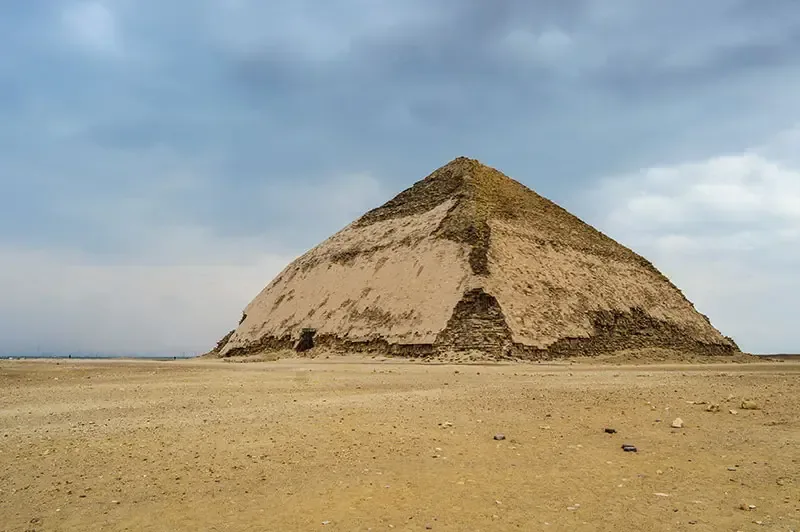
Forty kilometres south of Cairo, in a desert field far from the tour-bus circuits of Giza, stand two pyramids that together tell a story no other site in Egypt can tell: the story of how pyramid-builders learned, through a dramatic structural crisis and a bold engineering correction, how to build a true smooth-sided pyramid. The Bent Pyramid and the Red Pyramid at Dahshur were both built by the same pharaoh — Sneferu, founder of the Fourth Dynasty and father of Khufu (builder of the Great Pyramid) — within a few decades of each other around 2600–2590 BC. Together they represent the pivot point in Egyptian architectural history: the experiments that made Giza possible.
Dahshur receives a fraction of the visitors that Giza attracts — which makes it, in the opinion of many experienced Egypt travellers, the better experience. There are no touts, no camel rides, no crowds pressing against the stones. You can stand at the base of the Red Pyramid — the third-largest pyramid in Egypt, larger than Menkaure's pyramid at Giza — in something approaching genuine solitude, and descend into its interior chambers almost alone. This is extraordinary access to a monument of extraordinary historical significance, at a site that most of the world has not yet discovered.
Quick Facts: Bent Pyramid & Red Pyramid
| Feature | Bent Pyramid | Red Pyramid |
|---|---|---|
| Builder | Pharaoh Sneferu, 4th Dynasty | Pharaoh Sneferu, 4th Dynasty |
| Date built | c. 2600 BC | c. 2590 BC (built after Bent) |
| Original height | 104 metres | 105 metres (nearly identical) |
| Slope angles | 54.3° lower section; 43.3° upper section | 43.3° throughout (same as Bent upper) |
| Outer casing | ~60% of original limestone casing still intact — unique in Egypt | Mostly stripped; reddish limestone now exposed (gives name) |
| Can you enter? | Yes — opened to public 2019; steep descent, physically demanding | Yes — regularly open; three corbelled chambers |
| Significance | Only pyramid with two entrances; best-preserved outer casing in Egypt | First successfully completed true smooth-sided pyramid in history |
| Ranking by size | 4th largest pyramid in Egypt | 3rd largest pyramid in Egypt |
| Entrance fee | ~300 EGP (~$6 USD) for the Dahshur site — covers both pyramids | |
The Bent Pyramid: A Crisis in Stone
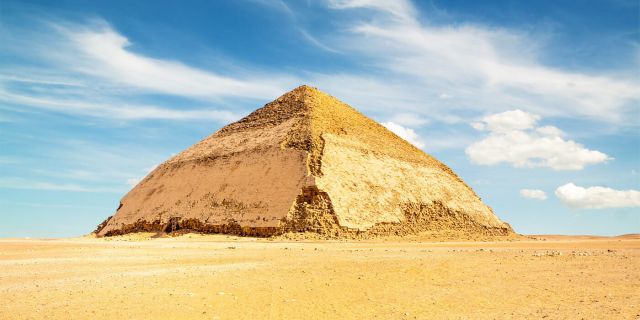
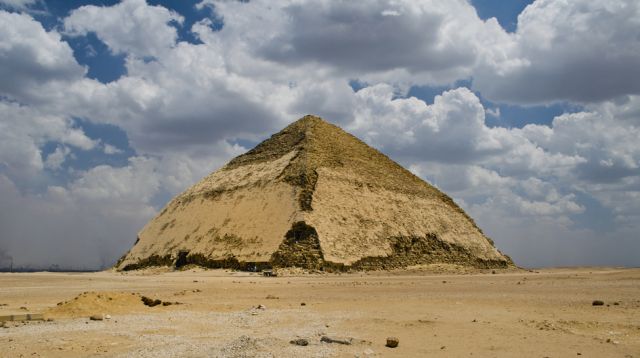
Sneferu began the Bent Pyramid with ambitious intentions. His builders laid the foundations for a true smooth-sided pyramid — the form that Imhotep's Step Pyramid at Saqqara had pointed toward — and set the walls rising at a steep 54.3-degree angle. This was steeper than any pyramid ever attempted, reflecting an ambition to build something taller and more dramatic than anything before it. For approximately the lower half of the construction, the plan worked.
Then, somewhere around the halfway point, something went wrong. The builders noticed that the structure was beginning to show signs of stress: cracks appearing in the casing stones, inward pressure on the internal chambers, evidence that the foundation — built on clay and compacted desert debris rather than solid bedrock — was shifting under the weight of the rising pyramid. The decision was made to change the angle.
At the halfway point, approximately 49 metres above the base, the slope of all four faces was abruptly reduced from 54.3° to 43.3° — a shallower, more stable angle. The pyramid was completed at this new gradient, giving it the distinctive double-slope profile that makes it unlike any other pyramid in Egypt and immediately recognisable from miles away. The result is not a failure — the Bent Pyramid stands in extraordinary condition 4,600 years later — but it is a monument to a lesson being learned under enormous pressure.
What no other guide tells you: The Bent Pyramid is the only pyramid in the world with two separate entrances and two separate internal systems. The northern entrance (the conventional pyramid entrance) leads to the lower chamber. A second entrance in the western face leads to a completely separate upper chamber via a different internal passage. No other pyramid in Egypt or the world has this feature — it is unique. Egyptologists believe the second entrance was added as a result of the structural crisis: the builders were hedging their bets on which chamber system would survive.
The Bent Pyramid's other great distinction is its preserved outer casing. While the Giza Pyramids were stripped of their Tura limestone casing in the medieval period (the stones used to build mosques and palaces in Cairo), the Bent Pyramid's lower section retains approximately 60% of its original smooth white limestone facing — more than any other pyramid in Egypt. Standing beside the lower courses, you can run your hand along the same polished stone surface that Sneferu's builders dressed and laid 4,600 years ago. This is what all the Giza pyramids once looked like: blinding white under the Egyptian sun.
The Red Pyramid: The First True Pyramid on Earth
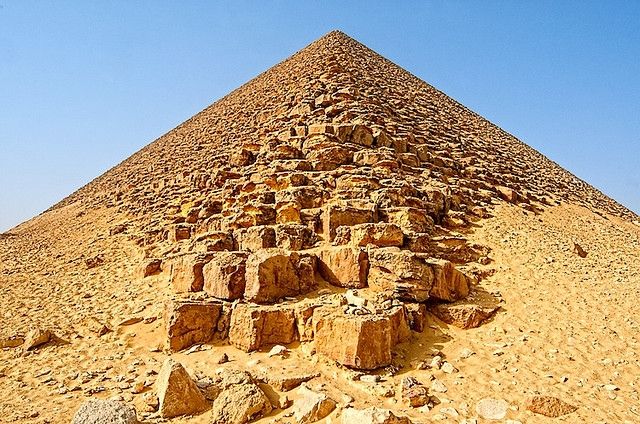
Having learned from the Bent Pyramid's structural difficulties, Sneferu began a new pyramid approximately one kilometre to the north. This time, every decision was different. The angle was set from the very beginning at 43.3° — the same shallow gradient that had stabilised the upper section of the Bent Pyramid. The foundation was prepared more carefully on more stable desert gravel. The internal chambers were designed with corbelled ceilings rather than flat stone lintels, distributing the enormous weight of the pyramid above them more efficiently. And the construction proceeded without incident, producing — for the first time in human history — a successfully completed true smooth-sided pyramid.
The Red Pyramid is the third-largest pyramid in Egypt, standing 105 metres high with a base of 220 × 220 metres. In its original state it was cased in fine white Tura limestone; the reddish-pink local limestone blocks exposed by the stripping of the casing in the medieval period give it the name it is known by today. Its dimensions are genuinely comparable to the great Giza pyramids: it contains approximately 1.69 million cubic metres of stone, making it larger than the Pyramid of Menkaure at Giza by a significant margin.
The interior of the Red Pyramid is regularly accessible to visitors — one of very few pyramids in Egypt where you can actually descend into the heart of the structure. The entrance on the north face, approximately 28 metres above ground level, leads down a steep descending passage 62 metres long (you must crouch; the ceiling is only about 1.2 metres high) into a sequence of three corbelled chambers of extraordinary height — the ceiling of each chamber rises 12–15 metres above the floor in a series of stepped stone courses that distribute the weight of the millions of tonnes above them. The chambers are empty, echoing, slightly humid, and profoundly atmospheric. Almost no other visitors will be present.
What no other guide tells you: The Red Pyramid was almost certainly Sneferu's actual burial place — not the Bent Pyramid that he began and struggled with. Fragments of a human mummy (dating to Sneferu's era) were found in the antechamber during modern excavations, though the evidence is not conclusive. Sneferu is believed to have been buried in the Red Pyramid, making him the first pharaoh interred in a true smooth-sided pyramid — the form that would define Egyptian royal burial for the next 1,000 years.
Sneferu: The Most Prolific Pyramid Builder in History
One fact about Pharaoh Sneferu is almost never adequately communicated by travel guides: he built more pyramid volume than any other pharaoh in Egyptian history — including Khufu, builder of the Great Pyramid. During his 46-year reign (c. 2613–2589 BC), Sneferu constructed three major pyramid complexes: the Meidum Pyramid (in Fayyum, his first attempt at a true pyramid, which partially collapsed either during or after construction), the Bent Pyramid at Dahshur, and the Red Pyramid at Dahshur. Together, the stone mass of these three structures exceeds that of Khufu's Great Pyramid.
His name in ancient Egyptian means "He Who Makes Beautiful" or "He Who Makes Good" — and the ancient Egyptians remembered him as a benevolent and popular ruler, very different from the somewhat authoritarian reputation of his son Khufu. The Westcar Papyrus, an ancient Egyptian story collection, portrays Sneferu as a cheerful, slightly bored king who calls his courtiers together to entertain him with stories. He is the most important pharaoh you have probably never heard of.
Visitor Information & Visit Strategy
| Detail | Information |
|---|---|
| Location | Dahshur, ~40 km south of Cairo, ~12 km south of Saqqara |
| Entrance Fee (2026) | ~180 EGP (~$3.60 USD) — covers both pyramids and the Dahshur site |
| Opening Hours | Daily 08:00–17:00 |
| Interior access | Red Pyramid interior: regularly open · Bent Pyramid interior: opened 2019, confirm access before visit |
| Physical requirements | Bent Pyramid interior is steep and claustrophobic — not suitable for those with mobility issues or claustrophobia; Red Pyramid is easier |
| Time needed | 1.5–2.5 hours at Dahshur covers both pyramids comfortably |
| Transport | Private car essential — no public transport; ~50 min from Cairo centre |
| Best combined itinerary | Giza Pyramids (morning) → Saqqara / Step Pyramid (midday) → Dahshur (afternoon) → Memphis — full pyramid evolution day |
| Photography | Excellent — far fewer people than Giza, no touts, clean desert backdrop; sunrise/sunset light spectacular |
The Pyramid Evolution: Saqqara to Dahshur to Giza
The three sites — Saqqara, Dahshur, and Giza — together tell the complete story of how ancient Egyptians invented, refined, and perfected the pyramid. Visiting them in sequence across one or two days creates one of the most intellectually satisfying experiences available anywhere in Egypt.
| Stage | Pyramid | Date | What It Solved |
|---|---|---|---|
| 1 — Invention | Step Pyramid (Djoser) | 2667 BC | Proved large-scale stone construction possible; invented the pyramid concept |
| 2 — Crisis & correction | Meidum Pyramid (Sneferu) | c. 2610 BC | First attempt at true pyramid — partially collapsed; revealed foundation problems |
| 3 — Angle problem | Bent Pyramid (Sneferu) | c. 2600 BC | Structural crisis mid-build revealed optimal safe angle: 43° |
| 4 — First success | Red Pyramid (Sneferu) | c. 2590 BC | First true pyramid successfully completed — proof of concept achieved |
| 5 — Perfection | Great Pyramid (Khufu) | c. 2560 BC | Largest pyramid ever built — everything learned from stages 1–4 applied at maximum scale |
Frequently Asked Questions — Bent & Red Pyramids
Why is the Bent Pyramid bent?
The Bent Pyramid changes slope angle approximately halfway up — from 54.3° to 43.3° — because the builders encountered structural problems during construction. Evidence of stress in the stones and a shifting foundation prompted an emergency change in the gradient. The reduced angle allowed the pyramid to be completed safely, giving it the distinctive bent appearance visible today.
What is the Red Pyramid named after?
The Red Pyramid takes its name from the reddish-pink colour of the local limestone blocks that form its core. Originally it was cased in bright white Tura limestone (like all ancient Egyptian pyramids), but this casing was stripped during the medieval period to build Cairo's mosques and palaces, exposing the reddish construction stone beneath.
Can you go inside both pyramids?
The Red Pyramid interior is regularly open to visitors — you descend a long steep passage into three impressive corbelled chambers. The Bent Pyramid was opened to the public in 2019 but access may be periodically restricted for conservation work. Always confirm before visiting. Egypt For Travel's guides will have the current status.
Is Dahshur worth visiting if I have limited time in Cairo?
If you have at least three days in Cairo, yes — absolutely. Dahshur adds only 1.5–2.5 hours to a day that already includes Saqqara, and the combination of the Bent Pyramid's unique double-angle form and the ability to descend inside the Red Pyramid in near-solitude makes it one of the most memorable experiences in Egypt. If you have only one day, prioritise Giza and Saqqara.
How do the Dahshur pyramids compare to the Giza Pyramids?
The Red Pyramid is the third-largest pyramid in Egypt — larger than the Pyramid of Menkaure at Giza. The Bent Pyramid is the fourth-largest. Together they contain more stone than all three of Menkaure's pyramids combined. What Dahshur lacks is the iconic visual impact of the Giza plateau; what it offers instead is accessibility, tranquillity, and the ability to actually enter and feel the interior of a great pyramid without competing with hundreds of other tourists.
What is the entrance fee for Dahshur?
The Dahshur site entrance fee is approximately 180 EGP (~$3.60 USD), which covers access to both the Bent Pyramid and the Red Pyramid. There is a small ticket booth at the site entrance.
Who was Pharaoh Sneferu?
Sneferu (reigned c. 2613–2589 BC) was the founder of the Fourth Dynasty and father of Khufu. He is the most prolific pyramid-builder in Egyptian history — the combined stone volume of his three pyramids (Meidum, Bent, Red) exceeds that of Khufu's Great Pyramid. Ancient Egyptian texts portray him as a cheerful, popular ruler. His name means "He Who Makes Beautiful" or "He Who Makes Good."
Visit the Bent & Red Pyramids at Dahshur with Egypt For Travel as part of a private full-day pyramid evolution tour — browse Cairo day tours from $60 per person. Includes Saqqara, Dahshur & Memphis · Private Egyptologist guide · All entrance fees · Air-conditioned vehicle. WhatsApp: +20 155 555 2466. ETA Licence No. 1947.