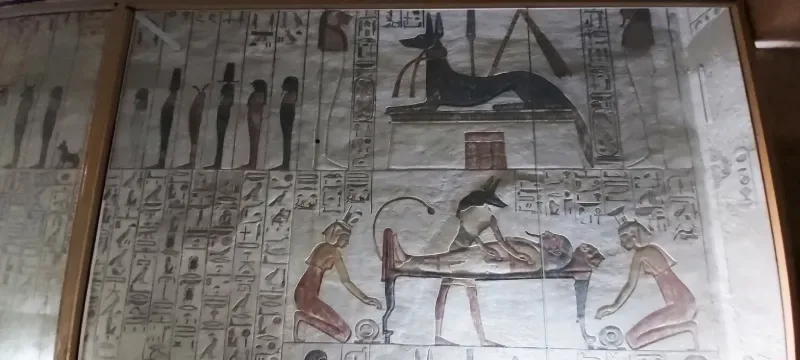
Every civilisation names itself, and the name it chooses reveals something essential about how it understands its place in the world. The ancient Egyptians named their land Kemet — written in hieroglyphs with the symbol of a strip of black soil — meaning "the Black Land." Not the land of the pharaohs, not the land of the gods, not the land of the pyramids: the Black Land. The name points directly at the foundation of everything — the narrow strip of dark, mineral-rich silt deposited each year by the Nile flood along both banks of the river, in which virtually all Egyptian agriculture took place and on which the entire edifice of Egyptian civilisation rested.
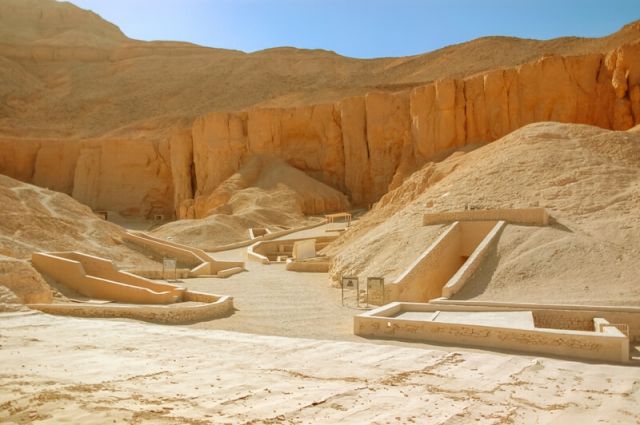
Kemet was defined by contrast. Beside it lay Deshret — "the Red Land" — the desert beyond the flood plain, hostile, dry, and dangerous, the domain of the god Set and everything that threatened the ordered world of Egyptian civilisation. The boundary between Kemet and Deshret was not gradual: it was a line you could straddle, one foot on black soil, one foot on red sand, the transition so abrupt that it has startled travellers for millennia. This binary — fertile and desert, life and death, order and chaos — is the organising principle of ancient Egyptian thought, encoded in the very name the Egyptians gave their world.
Quick Facts: Kemet
| Name | Kemet — ancient Egyptian for "the Black Land" |
| Written in hieroglyphs | The crocodile skin sign (km) + the bread loaf (t) + land determinative |
| What the black refers to | The dark Nile silt deposited by annual flooding — the most fertile soil in the ancient world |
| Its opposite | Deshret — "the Red Land" — the desert beyond the flood plain |
| Origin of "Egypt" | Greek Aigyptos — derived from Hwt-ka-Ptah ("House of the Ka of Ptah"), the Egyptian name for Memphis |
| Duration of Kemet civilisation | c. 3100–30 BC — over 3,000 years of continuous dynastic civilisation |
| Width of the Black Land | Typically 5–20 km on either side of the Nile — never more than a thin ribbon through the desert |
| Population of ancient Kemet | Old Kingdom peak: est. 1–2 million · New Kingdom peak: est. 3–4 million |
| Modern Egypt population | 105 million — 95%+ still live within a few km of the Nile, in the same Kemet strip |
The Black Land: Why the Nile Silt Made Kemet Possible
The annual flooding of the Nile — caused by the monsoon rains over the Ethiopian Highlands swelling the Blue Nile each summer — deposited a layer of dark, mineral-rich silt across the Egyptian flood plain each year between June and September. This silt was the product of volcanic soils from the Ethiopian Highlands, carried thousands of kilometres by the river and spread in a thin, extraordinarily fertile layer across the fields of Egypt. A single annual inundation provided enough nutrients to grow crops for an entire year without any additional fertilisation. No other agricultural system in the ancient world was this productive with this little effort.
The ancient Egyptians did not just benefit from this process — they built their entire civilisation around it. The calendar was organised around the flood. The tax system assessed and collected based on the flood level. The religion explained and celebrated the flood. The architecture was positioned relative to the flood line — temples and tombs built on the desert edge above the flood zone, agricultural villages and fields in the black silt below. Kemet was not simply a place name: it was a description of a relationship between a people and a river that sustained them for three millennia.
What no other guide tells you: The word kemet — black — also gives us the word alchemy. Medieval Arab scholars called the ancient Egyptian science of transforming substances al-kīmiyā — from the Arabic article al plus the Coptic rendering of kemet, kēme. The word passed through Arabic into Latin (alchimia) and then into English as "alchemy" — and eventually, shedding its mystical connotations, as "chemistry." Every time a chemistry student writes a formula, they are unknowingly referencing the Black Land of ancient Egypt.
Kemet's Contributions to Human Civilisation
The civilisation that grew from the Black Land made contributions to human knowledge and culture that are difficult to overstate. Many of the systems and technologies that we think of as foundations of the modern world were either invented or significantly developed in Kemet.
| Field | Kemet's Contribution | Legacy Today |
|---|---|---|
| Writing | Hieroglyphic script developed c. 3200 BC — one of the world's earliest writing systems | Coptic script evolved from Demotic Egyptian; influenced development of the Greek alphabet |
| Mathematics | Decimal system; geometry for land surveying; earliest known calculation of pi (c. 1650 BC, Rhind Papyrus) | Foundation of Greek mathematics; surveying principles still used in engineering |
| Calendar | 365-day solar calendar — the most accurate in the ancient world (see our calendar guide) | Direct ancestor of the Julian and Gregorian calendars used worldwide today |
| Medicine | Edwin Smith Papyrus (c. 1600 BC) — first known systematic medical text; describes brain, spinal cord, and surgical procedures | First rational (non-magical) approach to medicine; wound care, surgical practice |
| Architecture | Invention of large-scale stone construction (Imhotep, 2667 BC); column, arch, and vault development | Egyptian architectural forms influenced Greek, Roman, and ultimately all Western architecture |
| Agriculture | Irrigation systems; plough; systematic crop rotation and storage | Egypt was the breadbasket of the ancient Mediterranean world for 3,000 years |
| Art & aesthetics | Canon of proportion; composite perspective; colour symbolism systems that influenced Greek and Roman art | Egyptian artistic conventions influenced the development of Greek sculpture and architecture |
| Religion & philosophy | Concept of the soul (ka, ba, akh); judgment of the dead; resurrection; monotheistic episode (Akhenaten) | Egyptian religious concepts influenced Greek mystery religions, early Christianity, and Gnosticism |
Kemet's Religion: The Gods of the Black Land
The religion of Kemet was not a simple polytheism of interchangeable gods — it was a sophisticated theological system that evolved over three millennia, accommodating local traditions, historical change, and royal theology within a remarkably flexible framework. The Egyptians did not see contradictions between different creation myths or different explanations of the cosmos; they held multiple theological narratives simultaneously, understanding them as different perspectives on a truth that transcended any single account.
At the centre of Kemet's religious universe were a small number of fundamental principles. Ma'at — cosmic order, truth, and justice — was the value that the entire system was designed to uphold: the pharaoh's primary duty was to maintain Ma'at, the priests' function was to sustain it through ritual, and the judgment of the dead evaluated whether each individual had lived in accordance with it. Chaos (Isfet) — disorder, injustice, and entropy — was the perpetual enemy that Ma'at held at bay. The entire apparatus of Egyptian religion, from the smallest household ritual to the grandest state ceremony, was directed at maintaining the cosmic balance between these two forces.
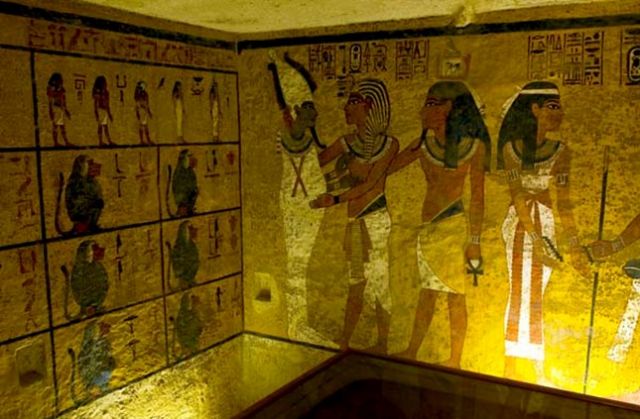
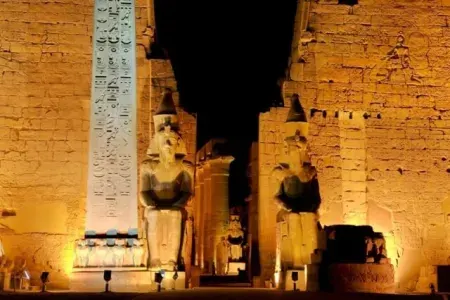
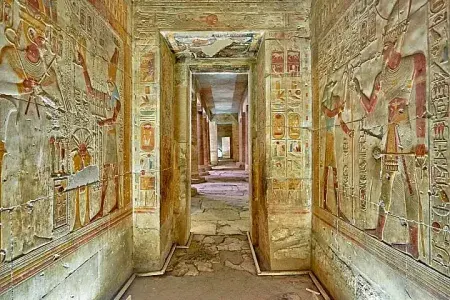
The gods of Kemet are encountered at every site you visit in Egypt today. Amun — whose sacred barque processed from Karnak to Luxor Temple during the Opet Festival — was the king of the New Kingdom gods. Osiris — the green-skinned god of death and resurrection — presided over the Valley of the Kings. Hathor — goddess of love and the sky — filled Dendera Temple. Horus — the falcon-headed son of Osiris — was embodied by every living pharaoh. Ra — the sun — sailed his solar barque across the sky each day and through the underworld each night, a journey that the tomb paintings of the Valley of the Kings depict in extraordinary detail.
Kemet's Social Structure: From Pharaoh to Farmer
Kemet was a hierarchical society organised around the divine institution of the pharaoh, but it was not a simple top-down structure. Understanding who lived in the Black Land and how they related to each other helps make sense of everything from the scale of the monuments to the survival of the ostraca from Deir el-Medina.
| Social Group | Role in Kemet Society | Evidence Today |
|---|---|---|
| Pharaoh | Divine king — embodiment of Horus in life, Osiris in death; maintained Ma'at; directed all state resources | Temples, tombs, statuary, inscriptions throughout Egypt |
| Priests | Temple administrators and ritual specialists — maintained the gods' cult statues; managed temple estates | Karnak, Luxor, Edfu, Kom Ombo, Dendera, Philae |
| Scribes & officials | Literate administrative class — tax collectors, legal officers, architects, doctors, military commanders | Papyri, ostraca, tomb inscriptions; Deir el-Medina records |
| Artisans & craftsmen | Skilled workers — stonemasons, painters, sculptors, carpenters; state employees on major projects | Deir el-Medina village; tomb paintings and carvings |
| Farmers | 80%+ of population — cultivated the black land during the agricultural season; paid taxes in grain | Agricultural tools, granary models, tomb agricultural scenes |
| Servants & labourers | Household workers; some enslaved (often prisoners of war); worked alongside free labourers on state projects | Legal papyri, household accounts, ushabti figurines |
Visiting Kemet Today: The Greatest Monuments of the Black Land
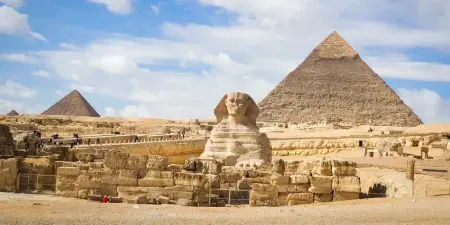
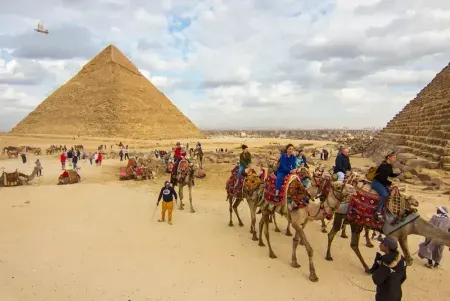
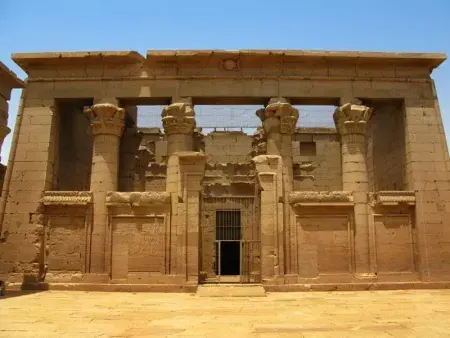
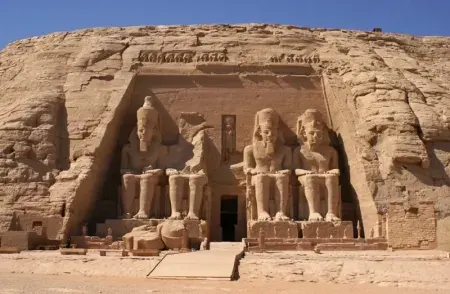
The monuments of Kemet are distributed across the length of the Egyptian Nile Valley — from the pyramids of Giza in the north to the temples of Abu Simbel in the far south. The Grand Egyptian Museum in Giza, opened in November 2025, now houses the world's largest collection of ancient Egyptian artefacts — including the complete treasures of Tutankhamun — and provides the most comprehensive introduction to Kemet's material culture available anywhere. It is the essential starting point for any serious engagement with the civilisation of the Black Land.
Egypt For Travel's Egypt tour packages cover the full span of Kemet's legacy — from the pyramids of the Old Kingdom at Giza and Saqqara to the New Kingdom temples of Karnak and Abu Simbel to the Ptolemaic temples of Dendera and Philae.
Frequently Asked Questions — Kemet Egypt
What does Kemet mean?
Kemet is the ancient Egyptian name for Egypt, meaning "the Black Land" — a reference to the dark, fertile silt deposited by the annual Nile flood along the river's banks. The name contrasted with Deshret ("the Red Land") — the surrounding desert. Kemet was written in hieroglyphs with the symbol of a strip of black soil.
Where does the word "Egypt" come from?
The word "Egypt" comes from the Greek Aigyptos, which the Greeks derived from Hwt-ka-Ptah — the Egyptian name for the temple of Ptah at Memphis (meaning "House of the Ka of Ptah"). The Greeks applied this name first to the city of Memphis, then to the entire country. The Egyptians themselves never used this word; they called their land Kemet.
What is the connection between Kemet and alchemy/chemistry?
The word "alchemy" — and through it, "chemistry" — derives from the Arabic al-kīmiyā, which incorporates the Coptic word kēme (the Coptic descendant of ancient Egyptian kemet). Medieval Arab scholars used this term for the ancient Egyptian practice of transforming substances, which they associated with the Black Land. The modern word "chemistry" thus carries an etymological connection to ancient Egypt's most fundamental self-description.
How long did Kemet's civilisation last?
The dynastic civilisation of Kemet lasted from approximately 3100 BC (the unification under Narmer) to 30 BC (the death of Cleopatra VII and Roman annexation) — a span of over 3,000 years. This makes it the longest-running continuous state civilisation in human history.
Is "Kemet" still used today?
The word Kemet survives in the Coptic language — the final stage of ancient Egyptian — as kēme, used to mean "Egypt" or "black." The Coptic Church still uses Coptic in its liturgy, making kēme a living word. Kemet is also used in Afrocentric studies and by some African diaspora communities as a preferred term for ancient Egypt, emphasising the African identity of the civilisation.
Explore the monuments of Kemet with Egypt For Travel — browse Egypt tour packages from $749 per person. Private Egyptologist guide · Pyramids, temples, tombs · The full story of the Black Land. WhatsApp: +20 155 555 2466. ETA Licence No. 1947.
.webp)
.webp)